


Publisher:COMPREHENSIVE STUDY IN INCOME TAX CERTIFICATION COURSES | ACADEMY TAX4WEALTH
Nov 04,2022
All You Need to Know About Comprehensive Study in Income Tax Certification Courses
Income Tax Certificate Courses are required to become a tax practitioner. A tax professional is well-versed in all taxation regulations and takes advantage of all available chances to lower the client’s tax bill. A tax specialist is crucial in handling tax benefits, liabilities, accurate payments, and so on. online accounting courses will teach you the fundamentals of numerous compliance requirements that must be met by the taxpayer, as well as several types of submission. These courses are meant to offer you in-depth knowledge of all parts of the Income Tax Act, the assessment procedure, and the filing of various returns.
These online accounting courses will teach you the fundamentals of taxation. It comes in a variety of formats, including certificates, diplomas, degrees, post-graduation, and even independent professionals such as Chartered Accountants and Cost Accountants that specialize in tax preparation.
There are various Income tax certification courses available both online and in the classroom format for persons who want to pursue a career in tax or professionals from other disciplines who want to better understand the notion of income tax.
A guide to Income Tax Certification Courses in 2022. Learn More About Career Opportunities After completing the Income Tax Course.
The courses are open to graduates of any degree. Individuals must select how to best enjoy the benefits of these , as anyone can enroll in it and its numerous uses. Income tax certification courses might help some people grasp income tax filing for personal reasons.
For others, this course may serve as a stepping stone to a good career in consulting. This course provides college students with further information on the topic of taxation.
These short-term certification courses in accounting, unlike structured specialist courses, do not have any defined eligibility criteria.
The Concept of Income Tax :
Income tax is not easy for everyone to understand or follow. Certain laws change regularly or are modified. Income tax is a complicated subject. The word income tax refers to the sort of government tax imposed on our earnings.
This tax is charged on the earnings of professionals and enterprises operating within their jurisdiction. The income tax is one of the government's primary sources of revenue. This sum is used for a variety of purposes, including national security, infrastructure costs, public service funding, and many more.
Who is this Course For?
Not everyone should take certain courses or studies. Some other courses have prerequisites and eligibility requirements, but not this one. Anyone interested in taking this course, regardless of educational background, is welcome to do so for both personal (knowledge enhancement or improved company management) and professional (career) reasons.
Let's take a brief look at the list below:
Anyone curious about and wants to learn about taxes.
Tax-related professionals having backgrounds in finance, such as CAs, CSS, CMAs, and lawyers.
Experts that desire to transition from the Finance to the Taxation fields
People with any level of education who are eager to comprehend how to submit taxes and the sophisticated intricacies of taxation
The CEO, CFO, analysts, executives, business owners, project managers, tax managers, and department leaders.
Professionals in the field of income tax.
Students who desire to specialize in or gain a deeper understanding of taxation topics and have a background in finance, business, tax, or accounting.
Business owners, SMEs, tax agents, and finance and accounting officers.
People/newcomers who desire to work in the taxes industry.
Career Opportunities After the Course:
After completing the income tax certification classes, there is a lot of career opportunity for a higher return profession. There is a wide variety of occupations accessible at various levels.
You could work as an auditor, tax accountant, tax examiner, accountant, tax analyst, revenue agent, tax collector, income tax officer, tax advisor, tax manager, tax attorney, tax planner, tax recruiter, revenue manager, business tax consultant, income tax consultant, property tax consultant, employment tax specialist, and financial advisor after completing the course.
The choices are limitless, with packages ranging from adequate to excellent. This course is also beneficial for business owners who manage taxes. With the assistance of the online taxation course, there is ample opportunity to begin or advance one's profession.
Having trouble making the right decision?
Numerous institutes provide various income tax certification courses. The course fees, duration of the course, teaching approach, and so on would fluctuate from one institute to the next, but the essential curriculum would remain the same.
Please consider your area of interest, your course requirements and expectations, your comfort, and the institute's ranking and recognition. Every course will concentrate on what the institute considers significant. Depending on the length and purpose of the course, the course content may vary slightly.
It is entirely up to you to select the course with the curriculum you prefer. You can make the ultimate decision by focusing on your goal. Having clarity on ideas like the purpose of taking the course and the objective to be reached makes it easier to make a decision.
Deciding becomes easier if you can pinpoint why you want to take the course. Once the rationale is obvious, you may quickly narrow it down to the one that meets your needs. If you can't decide, don't worry about it indefinitely. We are here to assist you in making the best decision.
FAQs:
1. What are the prerequisites for enrolling in the Income Tax Certification Courses? Is simply graduating from any field sufficient?
There is no such thing as a required prerequisite for this course. Graduating from any stream is OK, although persons with a commerce background or math and financial background have an advantage over others if they want to work in this field.
2. Is it possible to become an Income Tax expert by taking these courses?
Yes, with the help of this training, anyone may become a successful tax professional. It all depends on the institute the person chooses, as well as the person's interest and dedication to completing the course successfully; however, if the person opts for a comprehensive Income Tax course through an institution of good reputation, which includes the taxation foundations as well as the most recent changes in taxation policies, nothing is stopping the person from becoming a successful Income Tax Specialist.
3. Can you list the advantages of taking this course?
This course will help you understand the concept of Income Tax. You will have an in-depth understanding of the subject, which you may use to land a decent career as an Income Tax specialist, or if you are a businessman or the owner of a start-up, you can utilize this information to your advantage.
4. What fields may I pursue after completing this course?
After completing the Income Tax certification classes, a plethora of fantastic options will open up in front of you. You will be able to work in a variety of industries such as marketing, foreign commerce, public accounting, and so on.
5. Which institution offers the best Income Tax Certification Course?
Academy Tax4wealth provides exceptional, unrivaled Income Tax Certification courses. Their courses are designed to become income tax specialists by teaching practical applications. These classes are aimed at students of all skill levels, from beginners to masters. Classes are taught by distinguished and knowledgeable speakers, as well as highly seasoned CA professionals. The majority of these courses include at least one session of soft skills training. Some of these courses are free, while others are fee-based. The majority of these courses are taught both online and in the classroom.
All of the courses include a curriculum that will prepare you to be a successful tax consultant. The majority of these courses offer placement opportunities. So go ahead and select the best one for you. You do not need any prior knowledge or expertise to begin this short-term certificate course. Begin acquiring new skills, arm yourself with knowledge, and progress and refresh your profession right now. Income tax certification courses allow you to learn new skills that you can use to start a new job or advance in your current one. This course improves your professional prospects in a significant way.
To read our essential discussion covered by aninews.in
Click here 👉
https://www.aninews.in/news/business/business/gst-system-needs-a-lot-of-trained-professionals20221028144009/
Publisher:TOP 30 ACCOUNTING AND TAXATION INTERVIEW QUESTIONS AND ANSWERS FOR 2024
Nov 11,2022
Top 30 Accounting and Taxation Interview Questions and Answers for 2024
Accounting and Taxation are topics that will always be relevant. An aptitude for math and finance is necessary for accounting. Several abilities are needed to succeed in accounting and taxation interviews. These 30 accounting and tax topics must be covered if you want to succeed in your accounting and tax interview.
Here are the top 30 accounting and taxation interview questions and responses for 2024:
1. Introduce yourself ?
Ans: Even though the question sounds straightforward, the most important thing is how you answer it. First impressions are permanent. The proper introduction would aid in your job application and assist you to land the position. When you introduce yourself, delve into how passionate you are about accounting and taxation. Describe any instances in your life that involved computations. How taxation and accounting came to be your exclusive interests and passions. Making an impression on the employer during your introduction is worth a shot.
2. Please describe the various types of accounting ?
Ans: There are different types of accounting.
a.) Financial accounting: It keeps track of data about a company's financial situation.
b.) Administrative Accounting: It is concentrated on the administrative functions of the business. Planning and executing actions for the resources spent can benefit greatly from this form of accounting. It is employed to evaluate the accomplishment of goals and enhance the strategy that a company has put in place.
c.) Cost Accounting: This accounting category focuses especially on businesses with an industrial focus. The examination of production unit costs is handled by this accounting. examining how a company handles sales and its overall production process.
d.) Tax accounting: This accounting is concerned with recording and creating documents related to tax returns and payments.
e.) Management Accounting: This is a more comprehensive form of cost accounting because it keeps track of all a company's financial and economic data. It decides on both long- and short-term financial matters.
3. Which Accounting and Taxation Platforms Have You Worked With? Who Provided the Best Experience, and which?
Ans: The best e-learning platform for accounting and taxation is Academy Tax4wealth. We aim to skill the youth and provide them with 100% job placement assistance as well as training with business stalwarts.
4. How Can Accounting Accuracy Be Maintained?
Ans: Account An organization's maintenance of accuracy is a crucial task. This concept's inaccuracy could result in significant losses for the company. Errors can be reduced using a variety of methods and resources. Microsoft Excel is one such instrument. It is a tool that is quite compatible.
5. Describe Working Capital?
Ans: Working capital, which is used in daily trading, is the difference between current liabilities and current assets.
The idea of working capital focuses on the capital resources that a firm relies on upon the short term to operate if the accounting scheme is clear.
These resources include the company's cash, its assortment of financial goods, and its other holdings in assets.
6. How to Improve a Company’s Working Capital Flow?
Ans: The stock on hand would be my recommendation for enhancing the company's working capital flow. The part of working capital that we have control over is the stock.
Since they are independent legal companies, we can put pressure on our debaters to make payments as soon as possible but we cannot control them. Additionally, they are the ones giving us business.
We can postpone paying our suppliers, but doing so will inevitably harm our commercial ties and the reputation of the sector. The provider may hold up as a result of a payment delay.
Although they are beneficial, bank accounts cost money.
In the end, sticking to stocks is best. To have greater working capital, overstocking should be avoided, and the stock turnover rate should be high.
Nevertheless, this response is ambiguous because businesses like telephones and e-commerce operate with negative working capital. Therefore, before responding, be certain about the business you specify.
Also read; Top 20 Accounting Interview Questions and Answers
7. Explain how "Accounts Payable" and "Accounts Receivable" differ?
Ans: An essential component of accounting and taxation is accounts payable. The amount a corporation owns is called an account payable. Products and services were obtained from a source.
The amount that the business is entitled to receive as payment for the goods or services it provided to consumers on credit is known as account receivable.
In essence, liabilities are accounts payable and assets are receivable.
8. What are the most frequent accounting errors?
Ans: This accounting and taxation interview question is very significant.
The following are the most typical accounting errors: -
Absence of backup
Less communication between the accountant and the company
Combining your account with the companies
Resource allocation errors frequently occur
Manual accounting affects the efficiency
Receipts are lost
Accounting records are not updated
Mistakes in accounting
9. Do you have any experience with accounting standards? How many questions are there in India's accounting standards?
Ans: In interviews for positions in accounting and taxation, this question is regularly asked.
It is crucial to understand international accounting standards. Even if you've never held an accounting position, try learning more about it.
It is impractical to study everything about such a broad subject. However, if you are aware of the most recent updates, that would be fine.
To prepare you for interviews, online accounting and taxation would cover this subject.
10. What Distinguishes a Trial Balance from a Balance Sheet?
Ans: Both balance sheets, though they refer to distinct items, are our balance sheets. The enumeration of all account balances is known as a trial balance sheet. It is used to validate the accuracy of the math employed in recording and uploading.
A balance sheet is a declaration that lists a company's assets, liabilities, and equity. It is employed to evaluate its financial situation.
11. How Vital Is Accounting Documentation?
Ans: Accounting acts as an organization's watchdog, so it needs to be well organized.
The accounting team must give the company's stakeholders an accurate and fair picture.
As a result, accounting places a lot of emphasis on paperwork. To maintain an appropriate audit trail, sufficient documentation must be validated. When needed, it can also be justified.
In a way, accounting and taxation are nice jobs. You must maintain order and cleanliness in your work.
12. What are the main obstacles that could prevent accurate and timely financial statements?
Ans: The following are the main obstacles to financial statements in accounting and taxation:
• There is no balance between costs and benefits
• Delayed information is irrelevant.
• There is an imbalance in the qualitative traits
• The presentation of a fair and truthful standpoint lacks all clarity.
13. Mention the Golden Rules of Accounting Statements:
Ans: Taxation and Accounting both have their own set of guiding principles. They operate on a debit and credit system.
The following three principles govern accounting and taxation: -
Charge the giver a credit and debit the recipient.
Debit what is received and credit what is expended
Credit all gains and income; debit all costs and losses.
14. Describe your statement, "Debit the Receiver and Credit the Giver," in more detail:
Ans: In an interview for a position in accounting or taxation, this is yet another commonly asked topic.
In the event of personal accounts, this regulation is applied. Anytime someone donates money to a company, whether in cash or by utilizing a check, it counts as an inflow and is recorded as a credit in the books of accounts. This person gets given credit.
When an organization gets money in the form of cash or a check, it must credit the person who is paying the debt.
15. Give us three examples of how Excel will simplify your life:
Ans: Microsoft Excel is a very powerful program. It is one of the fundamental tools used in tax and accounting.
The software allows for the extraction of numerous reports.
Although the Software does not support reporting in a certain format. Excel is used in that situation.
Data can be organized and sorted with Excel, unnecessary files may be quickly deleted, and data can be displayed in a variety of ways.
Additionally, it is necessary for multiple connection data sets. As a result, many reports can be pulled from the software, sorted using the search feature, and then combined into a single report.
The use of Excel becomes crucial while conducting multiple reconciliations.
Want to make your career in accounting Click here 👉 How to Have a Successful Career in Accounting
16. How is the value of Deterred Tax Created?
Ans: When the tax liability is settled or carried forward, a deferred tax asset exists in accounting and taxation. There is no longer any way to record this carried-forward sum in the income statement. The difference between taxable income and book income is used to calculate this number.
17. What is your GST knowledge?
Ans: The largest indirect tax reform in India was the Goods and Services Tax, or GST. Other than the income tax, it is an indirect tax.
On the products or services, he offers, the seller levies GST on the customer. The vendor then deposits this sum with the government. On the large range of goods and services offered, the government has set different GST rates.
18. What Do Fictitious Assets Mean?
Ans: Fictitious refers to something false or made up.
An intangible asset with benefits that accrue over a longer time frame is referred to as a fictitious asset.
Goodwill, delayed income, rights, upfront costs, additional costs, accumulated loss, and many more items are examples of fictional assets.
19. What are the Perpetual Inventory System and Departmental Accounting System, respectively?
Ans: Accounting and taxation include the departmental accounting system. This kind of accounting data keeps track of all a department's financial transactions and data. This approach can be used to evaluate the profitability and productivity of each department.
A perpetual inventory system uses computerized point-of-sale systems and specialized asset management software to record inventory purchases and sales immediately after they have been made.
20. What are the Accounts Receivable and how do they relate to balancing?
Ans: Bills frequently appear in taxation and accounting.
Bill receivables are the earnings or money received. It is given to a business or retailer by its clients.
Equilibrating an account's credit and debit sides are known as balancing.
21. What is TDS, exactly? How Should TDS Be Displayed on a Balance Sheet?
Ans: TDS, or tax deducted at source, is the acronym. It is a theory that seeks to tax all sources of income equally.
On a balance sheet, TDS is displayed under assets. It follows the head current asset immediately.
22. Can a business with positive cash flows nevertheless be in trouble?
Ans: A company's success would not be guaranteed by positive cash flows.
If a company's working capital improvement is not sustainable and there is a lack of future income in the pipeline.
Positive cash flows thus don't necessarily indicate that a business is doing well.
23. Recognize the difference between dormant and inactive accounts.
Ans: Inactive accounts are terminated, shuttered, and stopped from being utilized moving forward.
On the other side, dormant accounts are not being used right now but might be in the future.
24. How many ledgers is a company required to have if it has three bank accounts for processing payments?
Ans: The organization would need three ledgers in such a case. For each account, one. By doing this, correct accounting and reconciliation procedures will be started.
25. How Can I Learn More About Bad Debts?
Ans: The following methods can be used to estimate bad debts: -
Outstanding accounts percentages
Aging analysis
Credit sales %
26. What does the accounting acid-test ratio equation (Q.26) entail?
Ans: The Accounting Acid-Test Ratio equation is: -
Acid-Test Ratio: Current Liabilities / (Current Assets – Inventory)
27. Name a few widely used accounting software programs. Which do you prefer, and why?
Ans. Software, CGram, Microsoft Accounting Professional, FinancialForce, Microsoft Dynamics AX, and Microsoft Small Business Financials are accounting programs that I am familiar with.
Microsoft Accounting Professional is my preferred program. It saves time and improves proficiency because of its dependable and quick processing.
28. Describe the Bank Reconciliation Statement:
Ans: The Bank Reconciliation Statement, often known as the BRS, is a document that enables us to contrast the records of our bank accounts and the banks. When the passbook balance and cash book balance diverge, BRS is implemented.
29. Describe the Fundamental Accounting Equation.
Ans: Assets, liabilities, and capital are the three main topics in accounting.
The basic accounting equation is as follows: Liabilities plus owner equity equals assets.
30. Describe CMM?
Ans: CMM, or capability maturity model, is another name for it. It is a document that offers a framework and the six components of infrastructure needed to measure the efficiency and capacity of a company's financial operations.
So, These are the top 30 Accounting and Taxation interview questions and responses for 2023
More Information on Accounting and Taxation:
The fields of accounting and taxation are very fascinating. Accounting and taxation are the appropriate fields for you to pursue if you have an interest in finance.
Math skills must be high for accounting. There are numerous opportunities for specialization in accounting. While participating in taxation, you should be constantly prepared to adapt to the shifting beliefs and schemes. Taxation involves good research skills.
Classes in accounting and taxation could assist clarify this complex subject. These courses are taught by knowledgeable instructors who have extensive experience working in the field. Your talents will advance if you receive instruction from professionals.
Accounting and taxation courses would cover a wide range of topics, including the fundamentals of accounting and taxation, various forms of accounting and taxation, GST, terms connected to accounting and taxation, and tax calculation.
Is it Worth It to Take an Online Accounting and Taxation Course?
It is, indeed. The new norm in education is online learning. Online tax and accounting courses are on par with traditional ones in quality. With their terms and conditions, they are secure. In today's environment, online courses are useful connections. They facilitate your interaction with professionals and peers from all over the world. These programs offer broader knowledge.
They possess a wide range of information. The most recent technology is used in accounting and taxation online courses. The utilization of the programs increases learning interactivity. The goal of online courses is to give you practical training.
Your skills would undoubtedly improve and you would be more prepared for the interview if you took accounting and taxes classes. Even on "the big day," they offer counsel and tips.
Online accounting courses are available at any time and from any location. All you need is a mobile device or laptop and a network connection.
Online classes give students 24/7 access to the instructor to clear up any questions. If you want to ace your interview, enroll in online tax and accounting courses.
Conclusion:
The field of accounting and taxation is wider. Do consider taking some accounting and taxation classes to help you prepare for the interview.
Attending an interview does not give you permission to pack answers into your head and deliver them to the company.
It takes confidence to succeed in interviews. Your posture and how you dress matter for the work. The basic objective is to impress the employer.
Clear answers are necessary during interviews. Avoid avoiding the subject. Answer each question courteously and succinctly. Don't drag out the process. Vague responses may disappoint the employer.
Do your research and development in addition to learning the questions and answers. The potential employer is curious about your knowledge base. Your prospects of winning are lost if your confidence wanes.
Certain personal information is required for interviews. Prepare the ideal resume. Your classes can assist you in creating one. Carrying your success certificates in this sector might also be a wise decision.
The structure for each of the aforementioned questions is set down for 2023. It is advised to read more articles on the challenging questions.
Also, Read 👉 https://hindi.news18.com/news/nation/increasing-trend-of-students-towards-online-training-courses-in-accounting-4773545.html
Publisher:INCOME TAX INTERVIEW QUESTIONS ANSWERS | ACADEMY TAX4WEALTH
Nov 16,2022
Top 30 Interview Questions and Answers for Income Tax
Introduction:
If you're looking for a job in the Income Tax department. This blog will serve as a resource for you as you prepare for Income Tax Interview Questions and Answers. To work in the Income Tax Department of the Government, one must pass both the (Union Public Service Commission) UPSC prelims and mains exams. Another option is to pass the Income Tax Department Selection Test, which comprises four papers. If the aspirants pass any of these, they would be qualified for an interview.
Q-1. Give a brief introduction about yourself
This is the first question that many interviewers ask. This is an icebreaker question, and the interviewer will frame the next question based on your response. It's a broad-reaching question that covers a lot of ground on the candidate. The interviewer asks this question to make the candidate feel at ease and to gain insight into the candidate. Never be overly enthused when answering this question, but always be honest. If it is answered correctly and professionally, the chances of being recruited increase.
Q-2. Describe income tax in more detail
This Income Tax Interview Questions and Answers serve as the foundation for an income tax. The government levies income tax on individuals' earnings to fund public expenditures or outlays to achieve the goal of social security. The tax is levied for the fiscal year at the rates set by the Central Government in the Union Budget for the fiscal year before the current year.
Q-3. How is the Income Tax calculated?
Income tax is determined based on an individual's total income from salary, company profits, capital gains, house property, and other resources. Every fiscal year, the income tax is determined using the tax slab published by the government.
Q-4: What do you mean by Total Income?
Total Income is the amount on which Income Tax is paid, including any income that occurs, accrues, is received, or earns in India. It excludes money generated outside of the country. It is the total amount earned by an individual or business, including income from providing services or employment, payments from pension schemes, dividend income, and sales revenue. Total income is determined for tax purposes, calculating an individual's or organization's ability to make debt payments, or determining a company's net worth.
Q-5. What is the difference between the Financial Year, the Previous Year, and the Assessment Year?
The Financial Year runs from April 1st to March 31st of each year. It is used in enterprises and organizations to calculate various financial evaluation statements every year.
The Assessment Year is the year immediately following the fiscal year in which the income from the preceding fiscal year is assessed. The assessment year is used by the government to assess the preceding year to collect taxes.
The previous year is the year in which income is earned and becomes taxable in the following assessment year. For example, if the current evaluation year is 2020-2021, the previous year is 2019-2020.
Q-6. What exactly do you mean by Assesses?
An Assesses is a person who is required to pay tax or any other quantity of money under the Income Tax Act. It includes anyone about any proceeding brought under this Act for the assessment of his income or the income of the other person in respect of whom he is assessable, or any loss sustained by him or such other person, or the amount refunded due to him or such other person, as well as anyone who is considered to be an assessee under any provision of this Act.
Q-7. How to decide the residential status of profits or income taxpayers?
Individuals' residential status is classified as Resident or Non-Resident under the terms of the Income Tax Act.
So, under Section 6(1), an individual is said to be a resident of India in any previous year if he meets any of the basic conditions, namely, he is in India for at least 182 days in the previous year or he is in India for at least 60 days in the relevant previous year and at least 365 days in the four years preceding that of the previous year.
If a person, regardless of nationality, fails to comply with this condition, they are classified as a non-resident.
Q-8. How does an individual's tax liability change as a result of his residency?
According to Section 5 of the Tax Act, a private's responsibilities are affected by his residence status and are also linked to the place and time of receipt of the income. There is a distinction between Indian and foreign income since Indian income is always taxable in India regardless of the individual paying the tax's residency status.
Q-9. What is Indian Income?
Indian income is defined as the money obtained or deemed to have been received in India during the previous year as well as the money accrued or deemed to have accrued in India during the same year. It is sometimes referred to as "Indian income" if the money was received in India during the prior year or was believed to have been received there during the prior year, or if the revenue was received abroad during the prior year but accrued in India during the prior year.
Q-10. What types of revenue are included in accumulated income?
Accrued income is money that has been earned but not yet received. Both the accounting period in which the money is produced and the period in which it will be received must be used to record the income.
Q-11. What is your knowledge of the fringe benefits tax?
The tax that an employer must pay for the perks that are provided to his employer in addition to the compensation is known as the "Fringe Benefits Tax." It is paid instead of the value of the fringe benefits that the employer gave or is alleged to have provided to his employees in the previous year.
Q-12: What exactly do you mean by "Capital Gain?"
The profit made from the sale of an asset is referred to as capital gain. When an asset is sold, the income or gain those results is the difference between the selling price and the purchase price. Short-term and long-term capital gains are both possible. If an asset is held for less than a year and then sold, it is considered a short-term gain; however, if the item is held for more than a year to three years and then sold, it is considered a long-term gain.
Q-13: What are your thoughts about AMT?
The Alternative Minimum Tax (AMT) is a tax that employs a distinct set of principles to assess taxable income after deductions. This is a method of discouraging rich people from evading taxes. It limits certain perks for higher-income tax groups and reduces the taxpayer's normal tax amount. If the tax benefits lower the total tax below the AMT ceiling, the taxpayer must pay a higher AMT amount.
Q-14. In India, is it possible to seek a refund for an overpayment of taxes?
Yes, there is a provision in India for receiving a refund of overpaid taxes combined with interest. When requesting a refund, one must file an income tax return within a certain time frame. The status of tax refunds can be tracked on the NSDL-TIN website by entering the Permanent Account Number (PAN) and the year of assessment for which the refund was sought under the Status of Tax Refunds page.
Q-15: What exactly do you mean by the ICR procedure, and how does it benefit you?
The Inter-Firm Reconciliation (ICR) method assists the parent company in separating itself from its subsidiary companies based on location. Businesses that are commonly controlled must prepare a consolidated financial statement for tax and reporting purposes each year. This method aids in the maintenance of accurate reporting as well as the avoidance of misinterpretation of the firm's financial status.
Q-16. What exactly is a Provident Fund? What are the different kinds?
The Provident Fund is a government-managed program in which both the employer and the employee contribute to the employee's wage.
Provident Funds are classified into 4 types: -
A recognized Provident Fund - RPF is a program that must be approved by the Income Tax Commissioner and applies to an organization with at least 20 employees.
An unrecognized provident fund - URPF - is established by employers and employees in a business and is not approved by the Income Tax Commissioner.
The statutory Provident Fund - SPF is primarily intended for employees of Educational Institutes (associated with universities).
PPF requires a minimum contribution of Rs.500 per year and a maximum contribution of Rs. 100,000 per year. Unless extended, the contribution and interest received are repayable after 15 years.
Q-17: What exactly is Excise Duty?
An indirect tax is charged on commodities manufactured in India that are intended for personal use. The taxable person is the manufacturer, and the excise duty responsibility originates from the items manufactured. The manufacturer pays this tax, which is then passed on to the customers.
Q-18: What exactly is service tax?
Service tax is a government-imposed indirect tax on certain services that are paid by customers rather than service providers. The service tax includes services such as AC restaurant services, motels, and inns.
Q-19: What is an Excise tax, and how does it vary from a Service tax?
Excise tax is another sort of indirect tax that is levied on the manufacture, sale, or use of specific goods or products. It is typically levied on items such as cigarettes or alcohol, as well as on the cost of activities such as gambling. Excise taxes can be levied by both federal and state governments. It differs from service tax in that it is levied on manufactured commodities, whereas service tax is levied on services rendered.
Q-20. Does an NRI have to pay property tax if he buys a property in India?
Any income or capital gain generated by an NRI from the sale, rent, or lease of a valuable property or asset based in India must be taxed by Income Tax guidelines. If the property is more than three years old, a long-term capital gain of 20% will be incurred on the sale of the property.
Q- 21: What is deferred tax liability? What goods are included in deferred tax liability?
Deferred tax liability refers to a tax liability that a firm owes but does not pay at the moment but must pay at some point soon. It is a balance-sheet item that accounts for the gap between future taxes owed and taxes paid today.
Deferred tax liability includes items such as unrealized tax and depreciation.
Q-22. What exactly is amortization?
Amortization occurs when a company's assets are written off over numerous years to renew or replace them and are not dependent on the asset's life. It is not synonymous with depreciation.
Q-23: What exactly is a deferred tax asset?
A deferred tax asset exists when a company pays taxes early or has paid too much tax and seeks money back from the tax authorities. The word appears on the balance sheet and is also referred to as a provision for future taxation.
Q-24. What do the terms Streamlined Sales and Use Tax Agreement mean?
Both titles were coined in 1999 by the National Governors Association (NGA) and the National Conference of State Legislatures (NCSL) to facilitate sales tax collection. Because sales tax is the second-largest source of revenue for the state after personal income taxes, collection needed to be streamlined. It resulted in the creation of a more straightforward and business-friendly sales tax regime. The Agreement reduced the expenses and administrative difficulties of collecting sales taxes on businesses, particularly those operating in many states.
Q-25: What exactly do you mean by taxation?
The government uses taxation as one of the methods to support its expenses by placing charges on corporate organizations and citizens. The government charges its population to encourage or discourage specific economic decisions.
Q-26: What exactly is a tax refund?
A tax refund is when the government returns the extra tax paid by an individual over the amount payable by the individual. When you file your income tax return for the year, the income tax, tax deductions or credits, withholdings, and other criteria are considered; you will then receive a tax refund.
Q-27: What exactly is fund flow?
Working capital is the primary source of funds. It describes the numerous sources of funds, which is highly helpful in comprehending long-term financial plans. The arrangement of changes in working capital shows the changes in current assets and current liabilities.
Q-28. What exactly is cash flow?
Cash flow is primarily determined by only one component of working capital, which is cash. It begins with the cash opening balance and ends with the cash closing balance. This is highly valuable for understanding short-term tactics that affect firm liquidity. The cash flow shows the changes in current assets and current liabilities.
Q-29: What do you mean by "Commercial Tax"?
Commercial Tax refers to the tax imposed on scheduled commercial items and collected indirectly by the seller or buyer against his business transactions, which today include sales, entertainment, luxury, admission, and profession.
Q-30: What exactly do you mean by "transfer income?"
Transfer income occurs when someone retains ownership of an asset while also agreeing to transfer its revenue, yet the income is considered his income and is added to the overall income.
Conclusion:
As a result, the aforementioned income tax interview questions answers are frequently encountered by candidates. If you wish to brush up on your skills and become an Income Tax Specialist, you can take the Income Tax Certification Course. This will not only help one prepare for selection tests, but it will also help one face a personal set of interviews. The set of questions and answers will also aid in answering objective-type inquiries. When one gets a position in the income tax department, they get various benefits such as job stability and a consistent salary, an assured pension, medical coverage, and other benefits.
Publisher:HOW TO UPLOAD TDS RETURNS ON INCOME TAX PORTAL | ACADEMY TAX4WEALTH
Nov 23,2022
How to Upload TDS Returns on Income Tax Portal
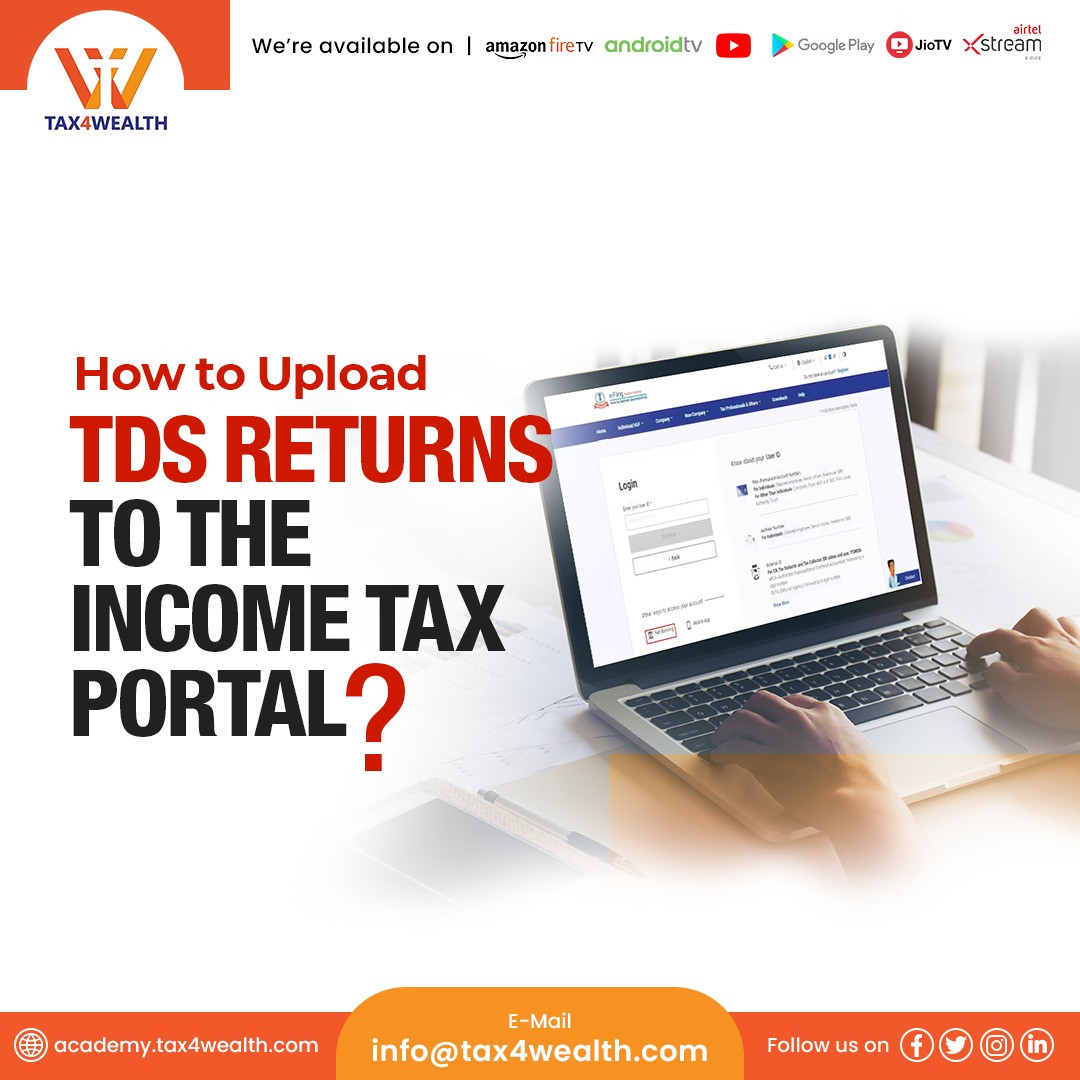
Do you want to know how to file a TDS return? We'll walk you through the process of filing a TDS return online, as well as where to file a TDS return. We'll also investigate how to upload TDS return online without using the software. Tax Deducted at Source (TDS) is levied on a variety of revenues, including salary, interest, commission or brokerage, dividends, and so on. It’s a kind of advance tax. The individual making the payment, known as the ‘deductor’, has a Tax Deduction Account Number (TAN) and is responsible for deducting the tax at source, depositing it with the government, and filing the TDS return on time so that the ‘deductees’ can claim the Tax credit.
Using the Income Tax Portal to Upload TDS Returns:
All business and government deductors must learn how to file TDS return online through the internet, according to Section 206 of the Income Tax Act (i.e., e-TDS returns). TDS return filing is, however, optional for other Deductors. TDS returns are submitted using the following forms:
Form
Type of Income
Form 24Q
Salaries
Form 26Q
Other than salaries
Form 27Q
Interest, dividend, and other payments to non-residents
Form 27EQ
Tax Collected at Source
The software for preparing TDS returns can be downloaded from the TIN NSDL website (https://www.tin-nsdl.com). All online TDS return filings must be prepared in the structured format supplied by the e-filing administrative authorities. The program, as well as the architecture, are accessible for use in validating the data required for the preparation of the e-TDS return.
TDS returns must be submitted every quarter. The following are the filing deadlines:
Period
Due Date
April - June
31st July
July - September
31st October
October - December
31st December
January - March
31st May
Late Filing Fees: According to section 234E of the Income Tax Act, the person who has deducted the tax, known as the Deductor, must pay Rs. 200 every day until the TDS return filing is completed. However, the penalty amount shall not exceed the TDS amount for which a statement filing was needed.
Penalty: Under section 271H of the Income Tax Act, a person who fails to file the TDS statement within the specified period shall be fined a penalty, the minimum of which is Rs.10,000 but which may be increased to Rs. 1,00,000 based on the circumstances of default. The penalty specified in this section is in addition to the penalty specified in Section 234E.
How to File a TDS Return:
In the following steps, we'll show you how to file a TDS return online:
Step 1: Go to the TIN-NSDL website and click on the 'e-TDS/e-TCS' tab under the services category to download the return preparing software.
Step 2: Select 'e-TDS/e-TCS RPU' and download the most recent RPU version available for TDS return preparation.
Step 3: Unzip the return preparation utility file; the FVU is a Java-based utility (JRE (Java Runtime Environment)) so make sure you have JAVA installed first; JRE is freely downloadable from http://java.sun.com.
Step 4: Choose Form No. '24Q' or '26Q' depending on the sort of return you wish to file, and then choose the 'Regular' statement type. Then click the 'continue' button.
Step 5: The first page has the fundamental information to be filled in, such as the 'Financial Year,' 'Quarter,' 'TAN No,' 'PAN No,' 'Address,' 'GST No,' 'Details of the person filing the Return,' who is usually the 'Authorised Signatory,' and so on.
Step 6: Fill out the challan details on the second page, such as 'Date of deposit of TDS Return,' 'BSR code of Bank from which TDS payment was made,' 'Amount Deposited,' and so forth.
Step 7: On the Annexure page, include any necessary information about the 'Deductees,' such as their name, PAN number, the amount remitted, tax deducted, rate at which tax was deducted, TDS section under which TAX was deducted, and so on.
Step 8: Download the CSI file from the TIN-NSDL website, double-check the details, then click the 'Create File' button. A pop-up box will appear asking you to upload the CSI file, after which you may select the folder where you want to keep the return files.
Step 9: After uploading the CSI file, click 'Validate.' If the file is validated successfully, an FVU file will be generated and saved in the specified folder. This FVU file contains the details of the returns, which must subsequently be uploaded to the Income Tax website, as indicated below.
Online TDS Return Filing Procedure:
Let's take a look at how to file a TDS Return Online
Step 1: Create an account on the TRACES website.
The following items are necessary to register on the Traces portal:
Acknowledgement of receipt of the most recent TDS return filed at the Facilitation Centre
Challan and challan-by-challan deduction information
Steps to Become a Tax Deductor:
Navigate to https://www.tdscpc.gov.in/app/login.xhtml.
Then, click 'Register as New User,' select Deductor from the drop-down list, and fill out the form to get registered.
Step 2: Visit the Traces website.
After logging in, go to fast links and select "Register at E-Filing Site."
Double-check information such as the 'PAN of the organization 'TAN of the organization and 'PAN of the authorized signatory.'
Select Redirect to incometaxefiling.gov.in from the drop-down menu.
Step 3: TDS Registration
When you click redirect, you will be taken to the Income Tax Portal with pre-filled data. Fill in your password, mobile number, and email address, as well as the captcha, and then click submit.'
Go ahead and register. Once completed, a confirmation message stating "registering in E-filing" will be displayed.
Step 4: Go to the Income Tax Portal
Log in to the Income Tax Portal (http://www.incometaxindiaefiling.gov.in) using your usual login information (PAN, DOB, and password), then go to the 'worklist' tab and click on 'For Your Action' to view my pending actions. A screen will emerge with all of your information, such as your PAN, name, mobile number, email address, and so on. Confirm by clicking on the TAN Number.
After you confirm, you will receive a notice stating that your request has been authorized successfully.
After confirming your PAN login, you will receive an SMS with a link to activate your user ID. Enter your mobile PIN and click "Submit" Then you'll see the notice 'The user ID has been successfully activated.'.
Log in to the Income Tax website using 'TAN' as your ID and the password you created when you registered. You will now notice a new tab 'TDS', place the cursor there, and select 'Upload TDS' to file the return.
TDS Return Upload Requirements:
Before commencing the process of uploading the TDS return filing, it is critical to have the following items ready:
To upload a TDS Return, the user must have a valid TAN and be registered in e-Filing.
TDS statements must be prepared with the Return Preparation Utility (RPU) software and validated with the File Validation Utility (FVU). This software is available for free download from the TIN-NSDL website (https://www.tin-nsdl.com).
A valid DSC that has been registered for e-filing (In case anyone wants to upload using DSC).
The bank account details of the principal contact should be pre-validated, or the principal contact's PAN should be linked with Aadhar (If you wish to upload using EVC)
How to Upload a TDS Return to the Income Tax Portal:
Go to the Income Tax E- Filing Portal: Go to the e-filing homepage, http://incometaxindiaefiling.gov.in, and click 'Login Here.'
Enter your TAN No. in the user ID field and click 'Login' to enter your account.
Explore the Dashboard: After logging in, you will see the tab 'TDS,' and by clicking it, you will see the 'Upload TDS' option.
Fill out the 'Statement Details' form with the necessary information: This is the initial stage in submitting the 'TDS Return,' and you must select the following options
Choose the FVU version on which you prepared your return,
Choose the Financial Year,
Fill Form Name,
Choose the Quarter of the Financial to which the Return belongs,
Select the Upload Type
Finally, click 'Validate' to validate the statement's details.
The returns can be validated in the following ways:
Using a DSC (Digital Signature Certificate)Using EVC (Electronic Verification Code).
Digital Signature Certificate validation(DSC), When the validation procedure is finished, you must upload the TDS file you prepared. Based on the information you previously entered, the 'Upload TDS Return' form will auto-fetch details such as the FVU version, financial year, quarter, form name, and upload type.
Click on Upload after uploading the compressed TDS file and the digital signature file created with DSC Management Utility.
After uploading TDS, you will see a success message on the screen and receive a confirmation email to your registered email address with the subject 'Your TDS return has been submitted successfully and the Transaction ID is XXXXX'.
For those who want to confirm using EVC or Electronic Verification Code, repeat step 7 above, but instead of 'attach the digital signature file,' you will find the option 'Click here to E-verify,' thus after uploading the TDS file, click on
'Click here to E-verify.'
Conclusion:
You may easily upload your TDS return file using this guide. TDS returns can now be uploaded from anywhere, at any time. So, no more queuing or hurrying to file your TDS returns.
For more information, Visit us at: https://academy.tax4wealth.com/
Publisher:INTEREST UNDER SECTION 220(2) OF THE INCOME TAX ACT | ACADEMY TAX4WEALTH
Nov 25,2022
Section 220(2) of the Income Tax Act - Interest Payment Regulations
What does the Income Tax Act's Section 220(2) mean? Learn about the Income Tax Act's payment requirements and the severe legal penalties in Section 220 (2).
The Income Tax Act includes provisions for late payment of tax demands, interest, and penalties under Section 220. (2). It stipulates that if the specified sum is not paid within 30 days, the taxpayer shall pay 1% interest every month. Section 220(2) of the Income Tax Act states that the Assessing Officer may only cut or remove interest if there is a good explanation. The taxpayer must pay interest under the Income Tax Act section 220(2) until the whole amount specified in the demand letter is paid.
What Is the Income Tax Act?
The Income Tax Act of 1961 is the legislation used in India to impose, manage, collect, and recoup income tax. It went into effect on April 1, 1962.
Individuals are liable to income tax, as well as any applicable surcharges and cess, at the rates set out in the applicable Central Act for the fiscal year. The Income Tax Act establishes separate standards for taxing income that has been received in advance as well as income that has not yet been received. A person must keep track of the TDS deducted when calculating his overall tax burden at the end of the year.
To Learn all the TDS related content Click here 👉 TDS Course- How to File TDS Returns Online
Every person's income must be classified under one of the following categories, as stipulated by the Act: -
Revenue from a home investment
Salaries
Earnings from unrelated sources
Profits from a business or profession
Capital gains
Types of Taxes :
Income tax is important because it provides cash to keep our government running. It is impossible to avoid imposing it on money created or used in the country because it is one of the government's primary revenue sources. It helps a country obtain the resources it requires for national development and other defense-related matters.
Income tax is classified into two types:
1. Indirect Taxation
Indirect taxes are those in which the persons who pay the tax and the people who are affected by it are two distinct entities. In most situations, these taxes are added to the price of the goods or services provided to the public, and the person in charge of collecting them from their customers deposits them. The GST is one of the most well-known indirect tax regimes.
2. Direct Taxation
Individuals and other entities must pay direct tax on their earnings. It is a sort of tax in which the taxpayer pays the government directly, implying that the taxpayer bears both the duty and the burden of the tax.
Important Definitions in the Income Tax Act of 1961:
1. Personal Income Tax
It is a tax levied on an assesses' full taxable income for the previous fiscal year, which the Central Government collects for each fiscal year.
2. Assesses
According to section 2(7) of the Income Tax Act of 1961, an assessor is a person who is required to pay taxes under any provision of that act. An assessment can also be applied to someone who has been the subject of judicial action or had their income examined under the Income Tax Act of 1961. Any person who is regarded as an assesses under the provisions of this Act or who is in default under one of these sections is considered an assesses.
3. Assessment:
Assessment is the process of determining whether or not the assessed reported income is accurate, calculating how much tax he owes, and then enforcing that tax duty on him.
4. Assessment Year:
The assessment year is 12 months commencing on April 1 and concluding on March 31 of the following year. It is the year in which the income from the previous year is calculated.
5. Person
According to Section 2(31) of the Income-Tax Act of 1961, a person is anyone who is:
An individual
A HUF (Hindu Undivided Family)
A Company
A firm
An association of people or bodies of people
A local authority
6. Income:
The definition of income in section 2 (24) includes, but is not limited to, the following elements:
Any unreported earnings received by the assessor • Any money earned on an irregular schedule
Any taxable profits derived from sources outside of India must be declared.
Any monetary advantage
Any help, recompense, or present of more than $50,000 given to an individual or HUF without payment
Any award
Causal revenues, such as earnings from lotteries or wagering on horse races, etc.
Deductions under the Income Tax Act of 1961:
Deductions may be claimed under the following sections of the IT Act of 1961:
Under Sections 80C, 80CCC, and 80CCD of the Income Tax Act of 1961, a person may deduct $150,000 from their taxable income.
Provision 80D: Medical expenses and health insurance premiums are tax-deductible under this section.
Section 80CCD of the Income Tax Act of 1961 focuses on the income tax deductions that an individual who is subject to income tax may claim for payments made to the Atal Pension Yojana and the New Pension Scheme (NPS).
Individuals who are Indian residents and HUF dependents obtaining disability medical treatment must claim the taxes deductible under this provision of the Income Tax Act.
Section 80TTA: This section allows a $10,000 deduction from interest-related income. This deduction must be paid by both HUFs and individuals.
Section 80DDB: Medical expenses incurred in the treatment of a certain condition may be deducted under this section of the Income Tax Act of 1961.
Part 80U: Under this section of the Income Tax Act, physically disabled individuals can deduct up to ten lakh rupees.
What is Section 156?
Before proceeding with this article, it is critical to understand Section 156 of the Income Tax Act, which requires the Assessing Officer to serve the assesses with a notice of demand on Form No. 7 stating the amount owing in cases where any tax, penalty, fine, or another sum is owed under the Act.
If the amount listed in any of the above-mentioned notices of demand is not paid within 30 days of service, the assesses shall pay simple interest at a rate of 1% for each month or portion of a month. The intriguing term is from the due date of the payment until it is received.
220 Section (2)
According to the first proviso of Section 220(2), if the taxes owed under this section are lowered, the interest will be decreased by the same amount, and any additional interest paid will be reimbursed. Section 220(2) states that if the interest payable under Section 220 was previously lowered by an order under the first proviso, it will be increased as a result of an order under this section or Section 263. Income Tax Act section 220(2) requires the assessor to pay interest on the amount owed under such an order as soon as the due date has passed. Interest will be paid until the balance is paid in full.
Issue of Notices:
The Assessing Officer is responsible for sending out earlier notices ordering the taxpayer to make the requisite payments under the Income Tax Act section 220(2). When the assessing officer adjusts his or her assessment, a new notice of demand must be sent. The first notice of demand will be replaced by the second.
Waiver of Section 220 (2):
Regardless of what is indicated in Section 220(2), the responsible officer may reduce the interest due if the following requirements are met:
The assesses may face major hardship as a result of having to pay this amount.
Interest payments were not made on time due to factors beyond the assessor's control.
The assessors have cooperated in any investigation into the assessment of any process for the collection of any sum owed.
The Principal Chief Commissioner, Chief Commissioner, Principal Commissioner, or Commissioner, as applicable, shall issue a decision approving or denying the assesses request to reduce or waive interest within a year of the end of the month in which the application is received. If an application was still pending on June 1, 2016, a decision must be made by May 31, 2017, or sooner.
Furthermore, no order denying the application may be issued until the assessor has had an opportunity to be heard.
Conclusion:
Even though paying taxes can be difficult, following the law is always the best course of action. If the taxpayer does to comply, they will be liable to several penalties under the Income Tax Act section 220(2). If you're still worried about the steep fines, always pay your taxes on time!
Follow Academy Tax4wealth for the most recent updates, news blogs, and articles on micro, small, and medium-sized enterprises (MSMEs), business tips, income tax, GST, salaries, and accounting.
Look at the most important news by Academy Tax4wealth covered by the "Chanakya Mantra"
Also; Read 👉 https://chanakyamantra.com/2022/10/02/there-are-plenty-of-employment-opportunities-in-support-of-the-gst-system/
Publisher:THE BEST INVESTMENT STRATEGIES TO REDUCE TAXES | ACADEMY TAX4WEALTH
Dec 26,2022
The Best Investment Strategies to Reduce Taxes
A tax deduction is an important aspect of financial planning. An effective tax-planning strategy can accomplish the dual aims of assisting people in reaching their financial goals and reducing taxes at the same time. Investment Strategies: Know about the Best Tax Saving Investment Schemes to reduce taxes that meet your investment needs in India. Read the full blog to get more details.
Instruments and sections that reduce taxes:
1. Fixed deposit
By making investments in tax-saving fixed deposits, you can reduce your tax liability by section 80C of the Indian Income Tax Act, 1961. By making investments in tax-saver fixed deposits, you can deduct up to Rs. 1.5 lakh from your income. Such FDs have a 5-year lock-in period, and the interest received is taxable. Typically, interest rates fall between 5.5% and 7.75%.
2. PPF (Public provident scheme)
Public Provident Scheme is a well-liked investing tool for tax reduction. You must first open a PPF account at the post office or specific branches of public and private sector banks to use a long-term savings, Investment Strategies. A guaranteed rate of interest is earned on contributions to the PPF account. These deposits are eligible for Section 80C deductions worth up to Rs 1.5 lakh each fiscal year.
3. ULIP (Unit linked insurance plan)
ULIPs are long-term investment solutions that let you pick from a variety of equity, debt, or both funds. With ULIPs, you have the freedom to switch between funds to your financial objective. By sections 80C and 10(10D) of the Income Tax Act of 1961, investing in ULIPs can result in tax savings.
4. National Savings Certificate
National Savings Certificates are a savings bond program that primarily encourages participants with low to moderate incomes to invest while minimizing their income tax liability under Section 80C. If you have a savings account with a bank or a post office and have access to internet banking, you can purchase NSC certificates in e-mode. An investor may purchase NSCs for their account, on behalf of a juvenile, or in a joint account with another adult.
5. Senior Citizen Savings scheme
The Senior Citizen Savings Scheme (SCSS) is a government-sponsored savings program for anyone over 60. It provides a reliable and stable source of income for people's post-retirement years and delivers relatively high returns.
Section 80C of the Income Tax Act of 1961 permits tax deductions for principal deposits made into SCSS accounts up to a maximum of Rs. 1.5 lakh. This exemption, however, is only valid under the current tax laws. If a person decides to file tax returns using the new approach outlined in the Union Budget 2020, it is not permitted.
However, the interest is subject to taxation according to the taxpayer's applicable tax bracket.
6. Life insurance
Life insurance is an important factor in a person's financial plan since it protects the person's family in case of an emergency. Because of this, getting life insurance as soon as possible is the breadwinner's top priority for the security of the family.
Traditional life insurance (endowment) and market-linked life insurance (ULIP) both provide tax advantages to policyholders on the premiums paid.
Different life insurance policies include:
Plans for life insurance give policyholders tax advantages regardless of their nature.
Section 80C of the Income Tax Act covers life insurance premiums up to a maximum of Rs. 1.5 lakhs. Under Section 10, proceeds on death or maturity are tax-free (D). The claimed deductions are added to income and subject to the appropriate taxation if insurance is surrendered or canceled within five years.
Terms plan
Plans for endowment
Unit-linked plans, or ULIPs
Refundable plans
Retirement planning
Another type of life insurance is a pension. They are referred to as protection plans and they have a different goal than other insurance plans like term plans and endowment plans. Pension plans aim to support the individual and his family if he lives on, in contrast to protection plans, which are designed to financially safeguard the individual's family in the event of his death.
The Income Tax Act's Section 80CCC (a sub-section of Section 80C) covers pension contributions. The total deduction allowed under all of Section 80C's sub-sections cannot be more than Rs 1.5 lakhs.
At maturity, one-third of the accrued pension amount is tax-free, while the remaining two-thirds are considered earnings and are subject to marginal tax rates. In the event of the beneficiary's passing, the sum is tax-free.
7. Mediclaim or health insurance
The costs associated with an accident or hospitalization are covered by health insurance, or Mediclaim as it is more often called. By the sum assured, Mediclaim also covers pre- and post-hospitalization costs.
Section 80D of the tax code provides benefits for health insurance. Tax benefits are available on insurance premiums up to Rs 20,000 for senior citizens and Rs 15,000 for everyone else. The policyholder can claim a tax benefit of Rs 35,000 (Rs 15,000 + 20,000) if he pays a premium for his coverage of Rs 15,000 and Rs 20,000 for his elder parent. The amount received under critical illness insurance policies' maturity value is tax-free.
8. NPS (New Pension Scheme)
The PFRDA, or Pension Funds Regulatory and Development Authority, oversees the NPS, or New Pension Scheme. Any Indian citizen between the ages of 18 and 60 is eligible to participate. As a result of the minimal fund management fees, it is very cost-effective. The money is managed by the fund managers among three unique accounts with various asset profiles. Corporate bonds (C), equity (E), and government securities (G) (G). Investors have the option of actively managing their portfolios or passively (auto choice).
Under Section 80CCD of the Income Tax Act, contributions made to the NPS are tax deductible. This section's combined deduction cap, along with the caps for Sections 80C and 80CCC, cannot exceed Rs 1.5 lakhs.
Given the variety of possibilities, NPS is especially helpful for people trying to save money for retirement who have different risk tolerance levels.
9. Mutual funds that reduce taxes
Equity-linked savings systems (ELSS), often known as tax-saving mutual funds, are eligible for tax advantages. Tax-saving mutual funds invest in the stock market among other assets and are better suitable for risk-taking investors. Three years are the three-year lock on investments.
Section 80C of the Income Tax Act covers investments in tax-saving mutual funds up to a total of Rs. 1.5 lakhs. Under Section 10, proceeds on death or maturity are tax-free (D).
What investments should you make this year to minimize your taxes?
Tax season for both paid and non-salaried taxpayers officially begins on April 1st. A wise tax-saving investment should have both tax exemption and income-earning potential as goals.
It would be a wiser strategy to start investing in the first quarter of the fiscal year rather than waiting until the end of the fiscal year and using ad hoc tax-saving instruments, giving taxpayers more time to plan their investments and receive the highest possible returns. When choosing the investment strategy, factors such as the fund’s safety, liquidity, and return size should be taken into account.
The majority of tax-saving investment schemes are covered by Section 80C of the Income Tax Act, which entitles the taxpayer to an exemption of up to Rs 1,50,000. ELSS (Equity Linked Savings Scheme), Public Provident Fund, Life Insurance, National Savings Scheme, Fixed Deposits, and Bonds are among the alternatives available to investors.
For more update, Visit us at: https://academy.tax4wealth.com/blog