


Publisher:BENEFITS OF PAYING TAXES IN INDIA | ACADEMY TAX4WEALTH
May 05,2022
What are The Benefits of Paying Taxes in India?
Taxes are the basis of the economic strength of any country. The government of any country is able to operate public services on the basis of the revenue received. Be it the arrangements for national security or the construction of basic infrastructure or the operation of public welfare schemes, the government is able to discharge its specific responsibilities on the basis of the income received from the tax. It is also the sacred duty of a good citizen to pay his tax obligations on time and participate in the economic security of the country. Certainly the tools of tax management should be used by every citizen. But paying tax also has many advantages. Which is also necessary for every person to understand.
To become a CA or want to enhance your skill Learn professional Income Tax Certification Course
What is tax?
The tax is levied in each country. It is a mandatory financial fee, which is levied by the government of a country by the citizens or institutions of the country. Its purpose is the mobilization of economic resources by the government for the operation of the country's systems. The government has the main authority to determine the tax. They get this right by the constitution of the country. Taxes are levied by laws passed by legislatures at the central and state levels. Failure to pay taxes can also become grounds for compensation and punishment.
What are The Types of Income Taxes in India?
There are mainly two types of taxes in India first direct tax and second indirect tax.
1. Direct Taxes: Direct taxes are those taxes which are paid directly to the government by an individual or entity. This tax is directly levied on any person or organization, so it cannot be paid by any other person or organization. In India this tax is administered by the Central Board of Direct Taxes. Examples of direct tax are income tax, gift tax etc.
Read blog : What are The Types of Income Tax? How are They Imposed?
Some of the major direct taxes are as follows:
Income Tax: This tax is levied on the taxable income earned by any individual. Which includes salary, profit from business, rent received from house and investment etc. The Income Tax Act came into force in 1961 for the collection of income tax. Several measures of tax relief have also been included in this Act for investments in specific sectors. Provision for penalty etc. has also been made for not filing income tax return on time. Arrangements have also been made for those who are not able to file income tax returns within the stipulated time frame. Tax relief can also be found by making investments as directed under the Income Tax Act by filing income tax returns within the time limit.
Corporate Tax: Corporate tax is levied on the profits or income received by the corporate from the conduct of business. This tax is levied on domestic as well as foreign companies operating in the country. Income tax is levied on companies according to the income and entity of the corporate under the Income Tax Act 1961.
Dividend Tax: Dividend tax is levied on dividends received from equity or mutual funds. Under the new system from April 1, 2020, dividend tax is now being levied on the shareholders. Earlier this tax was levied by the Government of India on companies in the form of Dividend Distribution Tax.
Securities Transaction Tax: It is a direct tax levied on the purchase and sale of securities listed on the Indian stock exchanges. The securities mentioned by the Securities Transactions Act include derivatives, equities, bonds, etc.
Capital Gains Tax: Capital gains tax is a tax levied on the gain of the sale of an investment asset.
Gift Tax: Gifts received by an individual were taxed under the Gifts Act 1958. But it was abolished in 1988. Then tax on gift was reintroduced in the right of the beneficiary under Section 56(2)(5) of the Income Tax Act, 1961.
Wealth Tax:
With the aim of reducing economic inequality in the country, the provision of wealth tax has been made with the aim of increasing the participation of rich people in direct tax. Wealth tax is administered by the Wealth Tax Act 1957. Under this, one percent tax is levied on individuals, Hindu undivided families, companies whose income exceeds 30 lakh rupees annually. This tax was abolished in the budget of FY 2017 and replaced with an additional surcharge of 2 per cent on individuals having taxable income of Rs 1 crore or more in a financial year.
1.Perquisite Tax: Perquisite tax is a tax levied on various incentives and benefits given by corporations to their employees. These benefits include rent free accommodation, water, electricity, medical reimbursement etc.
2. Indirect Taxes: These are those taxes which are levied on the seller of products or service provider. These taxes are not imposed directly on an individual.
Major Indirect Taxes:
GST: GST i.e. Goods and Services Act was implemented from 2017 to bring uniformity, transparency in tax structure across India. Under this, taxes like CGST, SGST, UT GST, IGST etc are levied. GST is levied on each section of the supply chain. wherever it is used. About 17 indirect taxes, including service tax, sales tax, have been subsumed in GST.
Stamp Duty: This is also an indirect tax levied by the state governments on the purchase of property. It is also levied on other financial transactions like purchase of shares, mutual funds, etc.
Toll Tax: The purpose of this indirect tax is to collect funds for road construction and repair activities. This tax is collected by the state or central governments from those traveling on newly constructed roads.
Entertainment tax: Entertainment tax is levied on activities related to entertainment such as amusement parks, video games, celebrity stage shows, sporting events, etc.
Also read: Some Important Tips for Income Tax Planning.
What are the benefits of paying taxes:
A huge amount of money is required by the government for the operation of various arrangements and activities. With the income received by tax, the government is able to ensure the due discharge of its obligations. Due to which the people of the country can live their life in a convenient way. The needs of the government can be seen in the following forms, which can be met by the government from the income received from taxes etc.:
The government needs money to effectively implement and implement schemes related to public welfare which are related to education, housing, employment, poverty alleviation.
Sometimes there is an epidemic or natural calamity in the country. Huge money is needed for public health and other assistance.
The government also needs huge amount of money for the smooth functioning of public systems. The government is constantly trying to maintain law and order, crime control, etc.
For the development of agriculture, industry and service sector, the provision of basic infrastructure i.e. roads, electricity, communication, irrigation etc. is necessary. Strengthening of infrastructure requires huge investment by the government.
For national security, the government also needs money for the modernization of the three parts of the army, army, air force, navy etc.
The government also needs money to implement science and research related projects.
Regular elections are essential for a democratic system. The government also needs huge amount of money for election related activities.
The government also needs funds for the smooth conduct of public communication and transport activities.
To deal with the problem of economic slowdown etc. and also to implement the plans of economic development, the government needs huge amount of money.
The government also needs huge amounts of money for liabilities related to international financial institutions such as IMF, World Bank and also for diplomatic efforts at the international level.
The government also needs huge amount of money for agriculture, animal husbandry, environmental protection efforts.
Apart from this, there are many personal benefits of paying tax.
If you have documents to file income tax return, then you can get home loan, vehicle loan easily. Banks get an intuitive idea of your income on the basis of your income tax return and approve the loan easily.
Also, read this blog that is help to file ITR: Points to be kept in mind before filling Income Tax Return
Many foreign consulates ask for documents on your income tax return during the visa interview. This income tax return is mandatory for UK, USA and Canada. Your income tax return is supposed to be proof that you are not moving out of the country for tax evasion. Also, the presence of income tax return documents with you while traveling abroad saves you from many troubles and also becomes the basis of convenience in getting help from the Indian Embassy.
Self employed, freelancers, consultants etc. are not entitled to Form 16. Income tax return documents are useful as a proof of their income.
Many a times income tax return documents are demanded while applying for government tenders.
Tax refund can also be claimed easily on filing of Income Tax Return.
Life cover or term policy with sum insured ranging from Rs 50 lakh to Rs 1 crore can be availed only by furnishing income tax return.
Self-employed persons are required to produce income tax return receipts to get the benefit of compensation in case of motor vehicle accident.
Short-term or long-term capital losses are usually carried forward to be adjusted against capital gains made in subsequent years. It can be availed only when Income Tax Return has been filed.
The income tax returns of the candidates for participating in the elections are also demanded by the Election Commission.
Timely payment of tax is the hallmark of a responsible citizen. The taxpayer lives the life of a citizen, he does not worry about the action of the Income Tax Department.
In this way, by paying tax, a person not only plays a role in the smooth functioning of the country's systems, but also contributes to the prosperity and development of the country. Also, payment of tax from time to time establishes a common citizen as a responsible citizen. The basis of the development of the nation is the payment of taxes from time to time.
Publisher:CONDONATION OF DELAY IN FILING INCOME TAX APPEAL | ACADEMY TAX4WEALTH
May 09,2022
How to File a Condonation of Delay in an Income Tax Appeal?
Timely filing of income tax returns is the hallmark of a responsible citizen. But filing an income tax returns is also a complicated process. Every step of which requires vigilance. The mere filing of an income tax return does not complete the process. Verification of income tax returns is also an important step. ITR is verified electronically through Electronic Verification Code or Aadhaar Time Password. Provided that for manual verification of ITR, the income taxpayer has to send a copy of ITR v acknowledgment to CPC, Bangalore through regular, speed post or registered post within 120 days of the filing of ITR. If this verification process is not completed then the ITR is not recognized by the Income Tax Department. Due to this, you will either have to file ITR again or you will have to face related problems.
What is the condonation of delay?
In general word condonation of delay means the act of condoning the delay in filing an appeal or application by the respective authority. Condonation of delay is generally applied for the delay in filing suits in the courts in India. It is also applied if the due date of filing ITR has passed and the taxpayer wants to file those past returns.
Does Income Tax Department allow delayed claims?
If the ITR is not manually verified by the income taxpayer within 120 days, then the ITR will be considered invalid by the Income Tax Department. The hassle of filing ITR again can be avoided if the apology request is made late. Provides condonation for the delay in any application filed under section 119(2)(b) of the Income Tax Act 1961. Income Tax Department allows delayed claims. The income taxpayer must state the reason for the delay in verification.
On what grounds delay condonation request is allowed:
- If the claim is genuine and true
- Income for which tax return has been filed is not assessable in the hands of any other person
- The income taxpayer has faced real hardship.
Is there any time limit for a late pardon request?
It is also to be noted that you will not be able to file ITR until your late condonation request is accepted. No time frame has been set for the approval or rejection of the apology request. It is generally seen that such requests are completed by the Income Tax Department in three to four months.
Enhance your knowledge and skills by purchasing our income tax certification Course.
What is the Process of Condonation Request for the delay in verification of your ITR?
Step 1: Log in to the e-Filing portal using your user ID and password.
Step 2: On your Dashboard, click Services > Condonation Request.
Step 3: On the Condonation Request page, select the Delay in submission of ITR-V option and click Continue.
Note: Select Delay in the submission of ITR-V in case you have not e-Verified your ITR within 120 days of filing.
Step 4: On the Delay in submission of the ITR-V page, click Create Condonation Request.
Step 5: On the Select ITR page, select the record for which you want to raise a condonation request for a delay in ITR-V submission and click Continue.
Step 6: On the Provide reason for delay page, select the reason for your delay and click Submit.
A success message along with a Transaction ID is displayed. Please keep a note of the Transaction ID for future reference. You will also receive a confirmation message on the email ID and mobile number registered with the e-Filing portal.
What is the process of Tracking the status of condonation of request:
Step 1. Login in to your e-filing portal account
Step 2. Select the option of service request available under my account.
Step 3. Select the option of view request under request type
Step 4. Select the option of condonation request under Request Category and click submit.
Step 5. On the next screen, you will have to listen to the condonation request filed along with their current status.
What action can be taken if ITR is not filed?
A late fee of Rs 5000 will be levied under Section 234F of the Income Tax Act. If the total income of the taxpayer is less than Rs 5 lakh per annum, then this late fee will be Rs 1000.
Interest shall be charged to the income taxpayer under section 234A of the Income Tax Act at 1 percent per month or part of the month for any amount of tax outstanding.
Non-filing of tax returns within the stipulated dates also does not allow the taxpayer to claim the benefit of certain deductions.
If the tax authorities believe that the tax return has not been filed with the intention of evading tax, then such an officer can levy a penalty under section 270A of the Income Tax Act which is equivalent to 50 percent of the tax saved by the taxpayer on account of non-filing of return. Will happen.
The Income Tax Department may initiate prosecution under section 276CC of the Income Tax Act in respect of the defaulting taxpayer punishable with rigorous imprisonment for a term which may extend to a minimum of 3 months to two years, and with a fine, depending on the amount of his evasion.
Therefore, every income taxpayer should take special care of the manual verification process of ITR while filing ITR. With mere caution, you can avoid the cumbersome process of filing ITR again. Hence every income taxpayer must be vigilant and alert during the entire process of the ITR file.
Also read this blog to know more about : How to File an Income Tax Return.
Publisher:TOP INCOME TAX CERTIFICATION ONLINE COURSES IN DELHI | ACADEMY TAX4WEALTH
May 30,2022
Top Income Tax Certification Online Courses in Delhi

Taxes are of special importance to the government for the orderly operation of the administrative systems of the country. Timely payment of tax is also considered a great duty for any citizen. Recently, the system of return of other taxes including income tax is being made mandatory. Especially in the context of income tax, other measures including investment are also arranged by the government for tax savings. The need for tax management has special significance for every taxpayer.
Given this, the demand for account professionals is increasing nowadays. The youth are also eager to take admission in the online income tax certification course. The reason is also that these After doing the courses, the foundation of a great career is also laid. Whereas the skill develops, so does the earning. Here I am going to discuss Best Online Income Tax Certification Courses Available in Delhi.
What is Income Tax?
An income tax is an important tax imposed on individuals or entities about the income or profits earned. Income tax is computed as the product of a tax rate times the taxable income. Taxation rates may vary by the type or characteristics of the taxpayer and the type of income.
What are The Benefits of an Income Tax Certification Course?
By taking an Income Tax Certification course, you become aware of the nuances of the Income Tax Act, of 1961, and equip yourself with basic knowledge about it. After doing this course you will be able to give accurate advice regarding Income Tax Management. Many types of investment arrangements are also created by the government for income tax savings. By giving this information to the income taxpayer, he can be of great help.
Click here: What are The Benefits of Paying Taxes in India?
Also, after doing Income Tax Certification Course, you become well aware of the procedures of Income Tax Return Filing, etc. Which is a special requirement for an Accounting Professional.
Who can do the Income Tax Certification Course?
Any student, who is looking to make a career as an accounting professional. For him, this course can give him a strong base. Any entrepreneur or business person, whose enterprise or business is about to be started or is going on. This course is beneficial for him. Any retired employee or officer who is interested in accounting and aspires to earn some money by utilizing the time available to him. This course is also beneficial for him. Any woman who is interested in tax management or wants to provide her service as an independent tax consultant.
Top 3 Income Tax certification courses in Delhi:
1. ITR Filing Course:
In this course, the method of filing income tax returns online in India is explained easily. In this course, information about the basic process of the tax system is also given. In this course, the process of how to file income tax returns online is explained in a very easy way. This course is provided by Academy Tax4Wealth. Information is provided through live and recorded video and 8 PPT. Which can also be downloaded. Sessions of this course are also running on Telegram. Video on demand is also made available. A certificate is also given on the completion of the course.
Click here for : ITR Filing Course Online.
2. TDS Returns Filing Course with a Live Practical Example:
Through this course conducted by Academy Tax4Wealth, complete information about TDS is provided and all the provisions related to TDS are told. The ill-effects of not filing a TDS return are also explained. How to report TDS return through live classes is also explained. Sessions of this course are also running on Telegram. Video on demand is also made available. A certificate is also given on the completion of the course.
Click here for : TDS Return filing Online.
3. Mega course on Presumptive Taxation:
The basic objective of this course conducted by Tax4Wealth is to develop expertise in the context of Tax Audit. In this course, specific information is provided about Section 44AB, 44AD of the Income Tax Act and Rule 6G of Income Tax Rules, 1962. Guidance note of tax audit is given. Sessions of this course run on Telegram along with live and recorded sessions. Video on demand is also made available. A certificate is also given on the completion of the course.
Also read : 10 Things to Consider Before Joining an Income Tax Course Online
In the present time, income taxpayers are giving special importance to tax management. It has also become imperative to file income tax returns on time. In such a situation, the demand for accounting professionals related to income tax is increasing.
In this context, the income tax certification courses of Academy Tax 4Wealth are especially excellent. After doing this, ample opportunities for employment and self-employment will be available.
Publisher:LINKING PAN CARD WITH AADHAAR CARD | ACADEMY TAX4WEALTH
Jun 09,2022
Know The Consequences of Not Linking a PAN Card with An Aadhaar Card
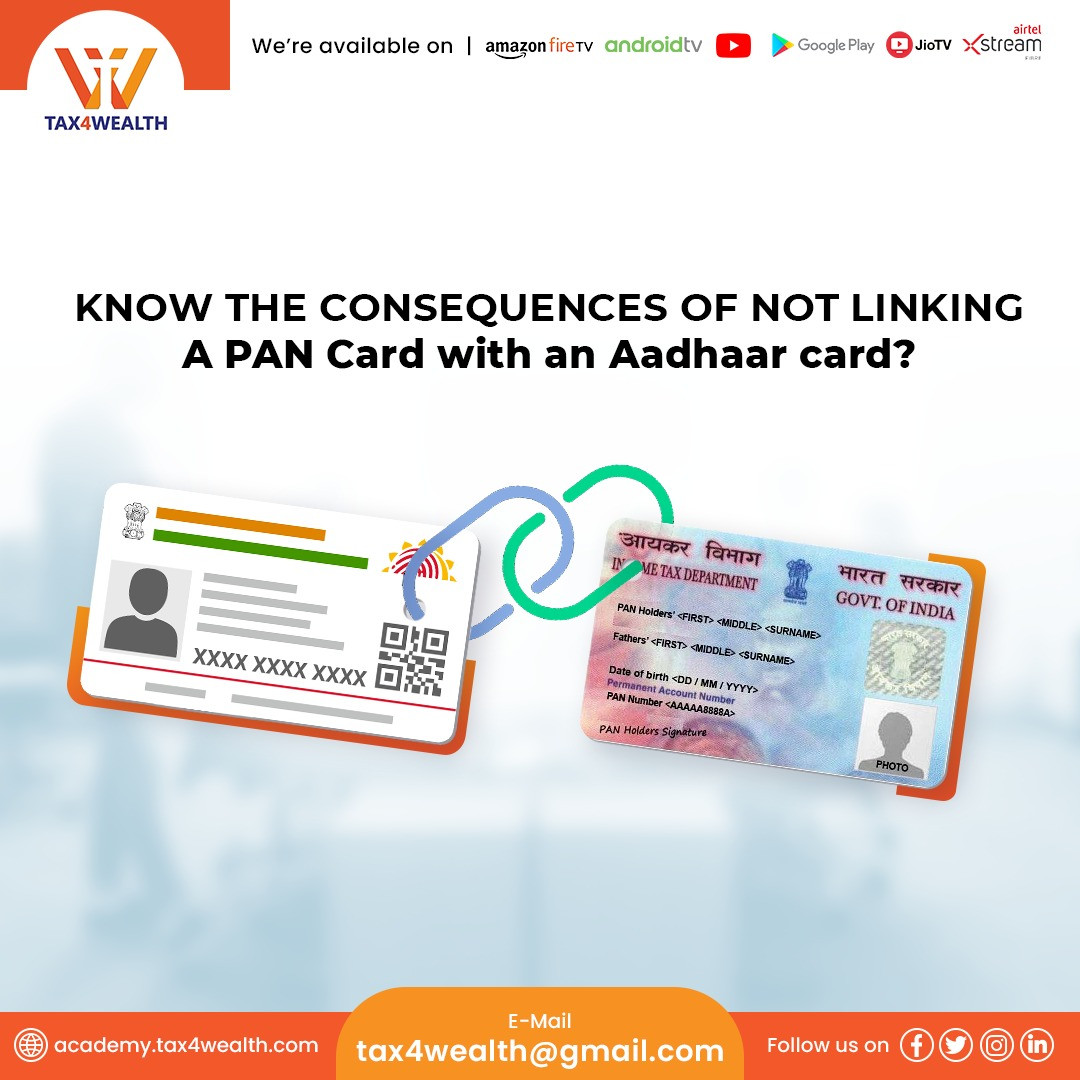
For the past few years, special drives are being run by the Government of India and the Income Tax Department to link the Aadhar card with the PAN card. It is worth noting that while the Aadhar card is the biometric identity card of every person in the country, the PAN Card is a sign of the specific tax status of a particular person. The objective of the government is to streamline the tax payer database and remove the irregularities involved in tax management. Also, the citizens also get a lot of facilities after the linking of Aadhar card and PAN card. So let's know the important aspects related to the linking of PAN card and Aadhar card.
What is Aadhar Card?
Aadhar card is issued by the Government of India to reveal the biometric identity of every person in the country. Through this card, a unique 12-digit number is given by the Unique Identification Authority of India. The existence of the fact of biometric identification in the Aadhaar card reduces the chances of forgery.
What is PAN Card?
PAN card is a special indicator of the tax status of every person. PAN ie Permanent Account Number is mentioned on the PAN card, which is used for paying taxes, opening a bank account, making investments, etc.
What is The Benefit to The Government by Linking PAN Card and Aadhar Card?
The problem of forgery still exists in the country with respect to PAN cards. Many people get two to three PAN cards made on the basis of wrong documents. In such a situation, the government does not get accurate information about the data related to investment expenditure. Due to which there are chances of tax evasion. But forgery is not possible with the Aadhaar card generated on the basis of biometric identification. One person can have only one Aadhar card. Therefore linking Aadhar card with PAN card gives the government a strong basis for the accuracy of its surveillance system. It also helps in curbing black money in the country's economy. This linking has special significance for the government even in the current context of the digital economy.
To learn more and upskill yourself, Check out Academy's Tax4wealth Income Certification Tax Course
What is The Benefit to The General Public by Linking PAN Card and Aadhar Card?
Due to this linking, you can easily authenticate your income tax return including other tax payments. This gets your work done quickly. Through this linking, when you open a trading account, the process of KYC i.e. Know Customer gets done easily. With the linking of Aadhar card and PAN card, you are also able to open an electronic account very easily. Also, the benefit of this linking is also available in getting a passport. You can get the job done in less time. This linking also facilitates in getting gas subsidy etc. The biggest thing is that this linking gives special help in ensuring the identity of the person.
What are The Financial Problems You May Face if Aadhaar Card and PAN Card are Not Linked?
The Government of India and the Income Tax Department have been issuing instructions to link Aadhar card with PAN card for the past several years. The last dates have been extended several times. Under Section 139AA of the Income Tax Act 1961, every person eligible to get Aadhaar and having PAN was directed to link Aadhaar with PAN. Till 31st March 2022 this link was happening without any fee payment. After that, whoever links PAN and Aadhar card between April 1 and June 30, then they will have to pay Rs 500. Whereas from July 1, 2022 to March 31, 2023, for linking PAN card with Aadhar card, one thousand rupees will have to be done. In the absence of linking of PAN and Aadhar card, there will be many problems in financial transactions.
1. Your PAN card will become useless if PAN is not linked with Aadhaar. Due to which your money will be deducted more in terms of TDS or TCS.
2. You will also have to pay a fine for not linking.
3. You will not be able to make an FD of more than fifty thousand rupees.
4. You will also not be able to deposit more than 50 thousand rupees in your bank account.
5. You will not be able to issue a new debit or credit card.
6. You will neither be able to invest nor redeem it in mutual funds.
7. You may also face trouble in taking loan etc. from any financial institution.
8. You will not be able to buy any foreign currency by spending more than fifty thousand. This will give you trouble in currency trading.
9. Along with this, there will also be many problems in the creation of electronic accounts, passports, filing income tax returns.
If you want to file ITR, you can join our online ITR Filing Course.
Who is exempted from linking Aadhar card with PAN card?
1. Those who do not have Aadhar Number and Enrollment ID for some reason.
2. Residents of Asom, Jammu and Kashmir and Meghalaya
3. According to the Income Tax Act 1961, those who come under the category of non-resident.
4. citizens over 80 years old who are Not Citizens of India.
How to Check PAN Card and Aadhar card linking?
Link: http://www.pan. uti itsl.com/panadharlink/forms/pan.html/panadhar
1. Enter PAN number and date of birth.
2. Enter the captcha and submit.
3. The linking status will start appearing on the next screen.
Linking of Aadhar Card and PAN Card is a mandatory fact. Otherwise, you will have to face financial complications step by step. Which will neither be in your interest nor in the interest of the country's economy. The most basic requirement for carrying out economic activities in a smooth manner is the linking of Aadhar card and PAN card. And perhaps even the identity of a responsible citizen.
For more details, Visit us at: https://academy.tax4wealth.com/
Publisher:PERMANENT ACCOUNT NUMBER (PAN)- PAN CARD | ACADEMY TAX4WEALTH
Jun 14,2022
Permanent Account Number (PAN) | PAN Card

Permanent Account Number in India is currently the most important economic document. After the instructions issued by the Reserve Bank of India, it has become an essential document to ease any kind of financial transaction. While the country's economic exchanges are monitored accurately by the government through PAN, citizens have convenience in many financial activities by having a Permanent Account Number (PAN). Let us know about the various dimensions related to PAN.
What is PAN?
The full name of PAN is Permanent Account Number. It is a 10 digit unique number, which is issued by the Income Tax Department in India under the Income Tax Act, 1961. A laminated PAN card is issued under the supervision of the Central Board of Direct taxes for PAN number. PAN card is required in almost every type of financial transaction. It is illegal to obtain or hold more than one PAN. PAN card is also used as an official identity card. The name of the person, father's name, date of birth and PAN number are mentioned in the PAN card. However, it cannot be used as an address proof. Since demonetization, on the advice of the Government of India, the Reserve Bank of India has made it mandatory for all account holders to link PAN with Aadhaar.
What are The 10 Characters of PAN?
PAN consists of an alphanumeric unique character of 10 characters. For example refer to this PAN: AIBWA5678P
The first five characters in it are from the English alphabet. The last also has an alphabet. The fifth alphabet is related to the name of any person or organization. After this there are 4 numerical digits from 6 to 9 characters.
What are The importance of PAN ?
1. Importance in The Context of Banking Functions
PAN card is a mandatory document in the context of opening a savings account, current account in any bank. Also, if you want to deposit more than 50 thousand rupees in any account, then it is necessary to mention PAN. PAN card is also necessary in the context of taking a credit card or loan from the bank. PAN card is necessary even if you want to make FD more than 50 thousand in the bank.
2. Importance with Respect to Income Tax Return:
Filing of Income Tax Return Under Income Tax Certification Course has been made mandatory for all. PAN is an extremely essential fact for filing Income Tax Returns. You have to give details of income and payments for the year in your income tax return. All these details are recorded with reference to PAN only. It is only through the PAN that the government is able to keep accurate monitoring of financial transactions. It is a mandatory fact for any Income Tax Officer to write PAN for all correspondence. Also, it is mandatory to provide PAN details on the challan for any payment due to the Income Tax Department (section 139A (5) a and b).
3. Importance in terms of Forex:
PAN is also an important document for you in the context of using or trading forex. Authorized money exchange bureaus or banks may ask for PAN for providing foreign exchange related facilities. It is mandatory for you to provide PAN even if you are earning in foreign currency.
4. Significance in The Context of Stock Market:
It is mandatory to have a demat account for investing in the stock market. The Securities and Exchange Board of India (SEBI), the regulatory body of the stock market, has made it mandatory to attach a PAN card to open a demat account for investment in the stock market. If you invest more than 50 thousand rupees in the stock market in mutual funds, bonds, and debentures, then it is mandatory to provide PAN card details.
5. Importance with Respect to Insurance:
If you buy an insurance policy for which the premium amount is more than 50,000 per annum, then you have to provide Permanent Account Number (PAN) details. This fact is mandatory for all types of insurance policies.
6. Importance in the context of buying a vehicle:
If you buy a vehicle worth more than Rs 5 lakh, then PAN details have to be given at the time of buying the vehicle. Also, it is mandatory to give PAN details even for the sale of high value there.
7. Significance in The Context of Expensive Jewellery:
According to the guidelines issued by the Government of India from January 1, 2016, if you buy jewelery worth more than two lakhs, then you have to provide PAN details. Whether this purchase is done with cash or by card. Also, PAN is required for payment of more than Rs 25,000 in hotels etc. on going for tourism.
8. Significance in Terms of Large Prize Money:
If you are associated with the field of sports, art, literature or science and you get prize money of Rs 1 lakh or more in any competition at the national or international level, then for that also you need to give PAN details. The winners of TV reality shows and quiz competitions also have to provide PAN details.
9. Importance with Respect to Purchase and Sale of Property:
In India, PAN has now been made mandatory for buying, selling or renting a property worth Rs 5 lakh. The PAN of both the buyer and seller is recorded in the sale deed of the property.
10. Significance in the Context of Financial Monitoring:
Permanent Account Number is becoming increasingly important in the context of financial surveillance in the country by the government. With this, the government gets instant information about the incidents of tax evasion. The mention of makes it easy to monitor every financial transaction.
Also Read; Know The Consequences of Not Linking a PAN Card with An Aadhaar Card
To whom can PAN be issued?
Any citizen of India can apply for PAN Card. No age limit has been fixed for normal PAN card but the minimum age limit to apply for instant PAN card generated with the help of Aadhar card is 18 years. it occurs. Any foreign national can also apply for Permanent Account Number.
What are The Documents Required for PAN?
Identity proof, address proof and date of birth proof are required to get a PAN. As proof of identity, any document has to be given as Passport, Voter ID Card, Aadhar Card, Ration Card, Driving License, Photo Identity Card issued by the State or Central Government. Whereas for address proof, one of the documents has to be given as Passport, Aadhar Card, Voter ID Card, Driving License, Post Office Passbook, Property Registration Certificate. Aadhar Card, Voter ID, Driving License, Passport, Matriculation Certificate, any one of the documents issued by the Municipal Authority is required for proof of date of birth. If the PAN applicant is a minor, then any of the above documents of any of his/her parents will serve as a proof of identity.
What is The Process of Making PAN?
PAN card can be made online or offline. To apply online for PAN, one has to login to the website (www.tin-nsdl.com) and fill Form 49A. To make PAN card offline, you have to visit the nearest service center. Required documents, two latest photographs and payment of prescribed fee. After applying for PAN, you get a tracking number from which you can check the status of PAN card generation. Normally, the PAN card is generated in four to five days. If there is any kind of error in the PAN card, then it takes 7 to 10 days to update after applying. Applicants who cannot sign are required to get the official seal and stamp on Form 49A attested by a Magistrate or a Notary Public or a Gazetted Officer by affixing the applicant's left thumb impression at the designated place of signature.
Does PAN have to be Changed on Change of City or Location?
PAN is a permanent number so there is no need to change PAN when you move from one place to another. PAN remains valid throughout the life of the holder.
In the context of today's changing economic scenario, Permanent Account Number (PAN) has become a strong essential element of economic activity. While it makes financial transactions easy for citizens, it has also become a strong basis for the government to monitor economic transactions. Overall, it can be said that PAN has been recognized as one of the most important economic documents today.
For more information, Visit us at: https://academy.tax4wealth.com/
Publisher:CAREER AS AN INCOME TAX INSPECTOR | ACADEMY TAX4WEALTH
Jun 29,2022
Career as an Income Tax Inspector
There is a special attraction for government jobs among the youth in India. The reason is that everyone wants a good salary and a secure job. The youth also have special attraction towards the post of Income Tax Inspector. Generally people know Income Tax Inspector only in the context of Income Tax raids. But the responsibility of the Income Tax Inspector is more than the role in the raids of the Income Tax Department. Let us know about the nature of Income Tax Inspector job, salary, other aspects related to career development.
Blog Contents :
Some Important Frequently Asked Questions Related to Blog:
✅ What is the role of Income Tax Inspector post?
✅ What is the job nature of Income Tax Inspector post?
✅ What is the educational qualification required to become an Income Tax Inspector?
✅ What is the age limit to become Income Tax Inspector?
✅ What is the Selection Process for Income Tax Inspector?
✅ What is the salary of income tax inspector?
✅ What is the career growth of Income Tax Inspector?
What is The Role of Income Tax Inspector Post?
The post of Income Tax Inspector is a Group C post of Central Board of Direct taxes. Every year a competitive examination is organized by the Staff Selection Commission to become an Income Tax Inspector. By the way, by giving different exams like SSC Stenographer, CHSL, MTS etc., one can also become Income Tax Inspector after promotion. But to become a Direct Income Tax Inspector, one has to clear the SSC CGL exam. The main role of the Income Tax Inspector is with reference to the basic roles of enforcement of the Income Tax Act.
Also read; Build your career with the best income tax courses online
What is the job nature of Income Tax Inspector post?
Income Tax Inspector has to discharge both desk and field duties. The Income Tax Inspector working in the assessment section of the Income Tax Department has to do a particularly desk job. Such as tax refund claims, income tax evasion complaints, TDS (File TDS Retrurns Online) etc. Whereas Income Tax Inspectors working in the Non-Assessment Section do field work and play an important role in the raids of the Income Tax Department. The work profile of Income Tax Inspector varies on a cyclical basis.
How much work does an Income Tax Inspector have to do per day?
The scheduled time for office work for Income Tax Inspector is from 9 am to 5.30 pm. But there is no fixed time during some special cases like income tax raids and search operations.
What is the educational qualification required to become an Income Tax Inspector?
To become an Income Tax Inspector, one has to appear in SSC CGL exam. The minimum educational qualification required to appear in this exam is graduation or income tax course from any recognized educational institution.
What is the age limit to become Income Tax Inspector?
The maximum age limit to become an Income Tax Inspector is 30 years. But some sections are also provided with some relaxation in the upper age limit for appearing in SSC CGL exam. For example, a relaxation of five years is provided in the upper age limit to the candidates belonging to SC / ST category. OBC candidates are given relaxation in the upper age limit of 3 years.
What is the Selection Process for Income Tax Inspector?
To become an Income Tax Inspector, one has to clear the three-stage exam of SSC CGL. In the first stage, the preliminary examination (online) has to be given. In the second stage, the main examination (online) has to be given. In the third stage, descriptive paper exam has to be given in pen paper mode (offline). Descriptive paper is in English / Hindi, which is of total 100 marks, the time duration is 60 minutes. In this, a letter and an essay have to be written. The qualifying marks in this paper is 33 which you have to get at least otherwise you will fail. By the way, the marks obtained in this paper also add up, so the more the number remains in this paper, the better it is. Total in all three phases.
The exam is for 700 marks. After that according to the cut off your numbers come, then you are selected for the post of Income Tax Inspector. There is no interview or physical test required to become an Income Tax Inspector.
Also read : A Complete Analysis of Section 194R of Income Tax.
What is the salary of income tax inspector?
The city in which the Income Tax Inspector is posted. Salary is given accordingly. Generally speaking about in hand salary to an Income Tax Inspector, then HRA, TA, DA together get an attractive salary per month.
What is the career growth of Income Tax Inspector?
After becoming Income Tax Inspector by passing SSC CGL exam, one becomes Income Tax Officer, which is a gazetted post of Group B. To become an Income Tax Officer, Income Tax Inspector has to pass departmental examination. Generally, it takes six to eight years for an Income Tax Inspector to become an Income Tax Officer. After that Income Tax Inspector can reach the post of Assistant Commissioner, Deputy Commissioner, Joint Commissioner, Additional Commissioner, Income Tax Commissioner depending on his work efficiency and experience. As far as the matter of getting promotion in how many years is concerned, it can be said that it takes different time for different posts in different zones.
There is a lot of craze among the youth to become Income Tax Inspector in India. By becoming an Income Tax Inspector, where one gets a secure job, there is also an attractive salary. Career growth opportunities are also available by becoming an Income Tax Inspector.
In the context of the duties performed by the Income Tax Inspector, a special prestige is also found in the society. That's why thousands of youth dream to become Income Tax Inspector in India.
If you want to build your career as an Income tax Inspector do visit our Income Tax certification Courses.