


Publisher:WHAT HAPPENS WHEN YOU MISS ITR DEADLINE | ACADEMY TAX4WEALTH
Jul 31,2023
What are The Consequences of Missing The ITR Deadline?
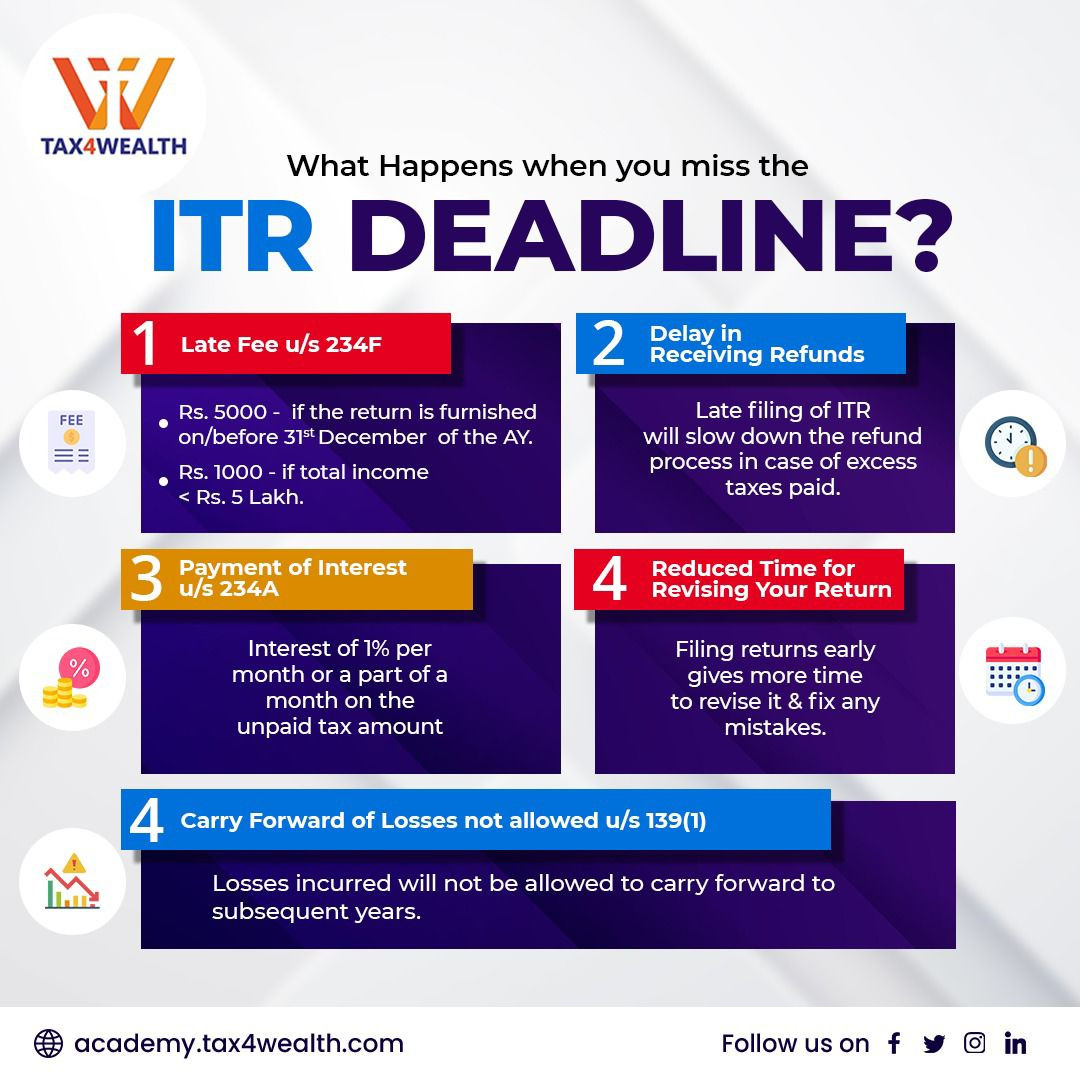
If you miss the ITR deadline, you may be subject to the following penalties:-
✅ Late filing fee
A late filing fee of Rs. 5,000 will be imposed if you are filing ITR after the due date. However, if your total income does not exceed Rs. 5 lakh, the late fee will be limited to Rs. 1,000
✅ Delay in refunds
In the case of late filing of the return, the process of refund will be delayed if the taxes are paid in excess.
✅ Lesser time to revise the returns
If you file your ITR early, you will have more time to revise and fix any mistakes.
✅ Carry Forward of losses not allowed
As per section 139 (1), Losses incurred will not be allowed to carry forward to subsequent years.
✅ Penal interest
If you owe any tax, you will be liable to pay penal interest on the outstanding amount from the due date of filing the return. The penal interest rate is 1% per month or part of a month under section 234A.
✅ Prosecution
In some instances, you may also be prosecuted for failing to file your return. However, prosecution is usually only initiated if the amount of tax evaded is significant.
You can still file your return after the due date, but you must pay the late filing fee and any applicable penal interest. You can file your return up to three months before the end of the relevant assessment year.
Here are The Steps on How to File a Belated ITR:-
1. Go to the Income Tax Department website
2. Click on the "e-filing" tab.
3. Click on the "Belated ITR" link.
4. Select the relevant assessment year.
5. Enter your PAN and password.
6. Fill out the belated ITR form.
7. Pay the late filing fee.
8. Submit the form.
For more update of ITR, Visit us at: https://academy.tax4wealth.com/blog
Publisher:ITR FILING: FAQS ON ITR FORM FILLING FOR AY 2022-23 | ACADEMY TAX4WEALTH
Aug 07,2023
FAQs on ITR Form Filling for AY 2022-23 - ITR Filing
The Income Tax Department has released the ITR forms for the Assessment Year (AY) 2022-23. Taxpayers use these forms to declare their income and claim deductions and exemptions.
If you are planning to filing ITR online for AY 2022-23, you may have some doubts about the process. Here are some FAQs to help you clear your doubts:
1. What is the deadline for filling ITR for AY 2022-23?
The deadline for filling ITR Form for AY 2022-23 is 31st July 2023. However, you can still file your ITR with late fees if you miss the deadline.
2. How do I Determine which ITR Form to Use?
The appropriate ITR form depends on your sources of income, residential status, and other specific circumstances. The Income Tax Department typically provides different forms (ITR-1 to ITR-7) catering to different taxpayer categories. For example, ITR-1 is for individuals with income from salary, house property, and other sources, while ITR-2 is for individuals and HUFs with more complex income sources.
3. What are the new changes in the ITR forms for AY 2022-23?
There are a few new changes in the ITR forms for AY 2022-23. These changes include:
✅ The introduction of a new section for reporting income from virtual digital assets (VDAs).
✅ The requirement is to disclose the Donation Reference Number (ARN) if the donation is eligible for Section 80G deduction.
✅ The requirement is to provide details of all foreign assets held by the taxpayer.
4. How do I file my ITR?
You can file ITR online or offline . To filling ITR form online, you can use the e-filing website of the ITD-. To file your ITR offline, you can download the ITR form from the ITD website and submit it to the ITD office.
5. What are the benefits of filing an ITR?
There are several benefits of filing an ITR. These benefits include:
✅ Get a tax refund, if you are eligible.
✅ Avoiding penalties for late filing or non-filing of ITR.
✅ Maintaining a record of your income and expenses.
6. What documents are needed to file an ITR?
Gather essential documents such as your PAN card, Aadhaar card, Form 16 (provided by your employer), bank statements, investment details, property ownership details, and any other documents related to your income sources and deductions.
7. Is it necessary to e-verify my ITR?
E-verification is crucial to complete the filing process. You can e-verify using methods like Aadhaar OTP, net banking, or physical verification by sending a signed ITR-V to the Income Tax Department.
Filing your ITR might seem daunting, but with the right information and guidance, you can navigate the process smoothly. Always double-check the information you provide and ensure its accuracy to avoid unnecessary complications in the future. If you're unsure about any aspect of filing ITR, it's advisable to consult a tax professional for expert assistance. Stay informed and file your ITR with confidence for a hassle-free financial year ahead!
Also, read; Complete Guide: Filing ITR-3 Online for AY 2023-24 with Important Due Dates
8. What is the importance of mentioning my bank accounts in the ITR?
Mentioning bank accounts in the ITR is vital to track financial transactions and verify the legitimacy of your income sources. It also aids in seamless communication between the Income Tax Department and taxpayers.
9. What documents are needed to file an ITR?
Gather essential documents such as your PAN card, Aadhaar card, Form 16 (provided by your employer), bank statements, investment details, property ownership details, and any other documents related to your income sources and deductions.
10. Can I revise my ITR after filing?
Yes, you can revise your ITR within a certain period after the original filing, if you discover any errors or omissions. This option is beneficial for rectifying mistakes and ensuring accurate reporting.
Get more update, Visit us at: https://academy.tax4wealth.com/blog/
Publisher:TAX BENEFITS OF HOME LOAN UNDER INCOME TAX ACT, 1961
Aug 10,2023
Analyzing the Tax Benefits of Home Loan under Sections 24B, 80C, 80EE AND 80EEA

For many individuals, owning a home is a dream come true. However, the financial aspect of purchasing a house can be daunting. Fortunately, the Indian government offers tax benefits on home loans, making it easier for people to fulfil their homeownership aspirations.
In this blog post, we will take a detailed look at these sections and explain how they can help you save money on your taxes. We will also provide some tips on how to maximize your tax benefits.
1. Analysis of Section 24B:
One of the most important benefits for borrowers is Section 24B of the Income Tax Act, 1961. This allows borrowers to claim on the interest paid. The maximum deduction available under 24B is Rs. 2 lakh per annum.
What is Section 24B of the Income Tax Act, 1961?
There are a number of conditions that must be met in order to claim under 24B. These conditions include:
✅ It must be taken for the purpose of acquiring or constructing a residential property in India.
✅ The property must be self-occupied by the borrower.
✅ The construction or acquisition of the property must be completed within 5 years from the end of the financial year in which the loan was taken.
✅ If these conditions are met, the borrower can claim a deduction on the interest paid on their home loan up to a maximum of Rs. 2 Lakh per annum. It is available for both pre-construction and post-construction interest.
What is Section 80C of the Income Tax Act?
Owning a home is a dream for many people in India. It is a major financial investment, but it can also be a great way to save money on taxes. The Income Tax Act, 1961 provides several benefits for loans, including deductions under Section 80C.
80C allows taxpayers to claim a deduction on certain investments up to a maximum of ₹1.5 lakh per year. Some of the eligible investments under 80C include:
✅ Life insurance premiums
✅ Provident fund contributions
✅ PPF contributions
✅ ELSS investments
✅ principal repayment
✅ Tuition fees for children
✅ Medical insurance premiums
✅ For Home Loan Principal Repayment
One of the most popular investments under Section 80C is the repayment of the principal amount of a loan. The maximum deduction that can be claimed for principal repayment is ₹1.5 lakh per year.
Conditions to claim the deduction under section 80C:
✅ It must be taken from a financial institution approved by the government.
✅ It must be used to purchase or construct a residential property in India.
✅ The property must be self-occupied by the taxpayer or their family.
✅ The property must not be sold within five years of the end of the financial year in which possession is taken.
How to Claim the Deduction :
To claim for loan principal repayment, taxpayers need to submit Form 80C along with their income tax returns. The form can be downloaded from the website of the Income Tax Department.
It will be claimed from the taxpayer's gross income. This means that the deduction will reduce the amount of tax that the taxpayer needs to pay.
Here are some additional points to look:
✅ The deduction for loan principal repayment is available only for the first five years
✅ If you sell the property within five years of the end of the financial year in which possession is taken, the claimed earlier will be added back to your income in the year of sale.
✅ If you take a joint home loan, each co-borrower can claim for the principal repayment up to ₹1.5 lakh.
2. Tax Benefits of Home Loans: Analysis of Sections 80EE and 80EEA:
Two of the most important benefits for homebuyers are Sections 80EE and 80EEA. These allow taxpayers to claim on the interest paid on their loan.
What is Section 80EE of the Income Tax Act?
80EE allows a up to Rs. 50,000 per financial year for the interest paid on a home loan. To be eligible for this deduction, you must meet the following conditions:
✅ You must be a first-time buyer.
✅ It must be taken from a financial institution.
✅ It amount must not exceed Rs. 25 lakhs.
✅ The property must be located in India.
What is Section 80EEA of the Income Tax Act?
Section 80EEA allows a deduction of up to Rs. 1.5 lakhs per financial year for the interest paid on a loan for affordable housing. To be eligible for this, you must meet the following conditions:
✅ You must be a first-time homebuyer.
✅ It must be taken from a financial institution.
✅ The loan amount must not exceed Rs. 45 lakhs.
✅ The property must be located in India and have a carpet area of not more than 60 square metres.
Comparison of Sections 80EE and 80EEA
The main difference between Sections 80EE and 80EEA is the maximum deduction amount. 80EE allows up to Rs. 50,000, while 80EEA allows up to Rs. 1.5 lakhs.
Another difference is the eligibility criteria. 80EE is only available to first-time buyers, while Section 80EEA is available to both first-time and subsequent homebuyers.
Finally, the amount limits are different for the two sections. The amount limit for 80EE is Rs. 25 lakhs, while the loan amount limit for 80EEA is Rs. 45 lakhs.
Which Section is Better?
The best section for you will depend on your individual circumstances. If you are a first-time homebuyer and the amount is less than Rs. 25 lakhs, then 80EE may be a better option for you. However, if you are a subsequent buyer or the amount is more than Rs. 25 lakhs, then 80EEA may be a better option for you.
How to Claim the Deduction for these sections?
To claim the deduction under Sections 80EE or 80EEA, you must file ITR with the relevant documents. The documents you will need to file your ITR include:
✅ The agreement
✅ The property registration documents
✅ The interest payment receipts
Publisher:TAN( TAX DEDUCTION AND COLLECTION ACCOUNT NUMBER) | ACADEMY TAX4WEALTH
Aug 16,2023
Everything about TAN: Tax Deduction and Collection Account Number
What is TAN?
TAN, or Tax Deduction and Collection Account Number, is an exclusive 10-digit alphanumeric code issued by India's Income Tax Department. This number is specifically designated for individuals who hold the responsibility of deducting or collecting taxes on behalf of the government. The legislative framework that governs TAN issuance and usage is outlined in Section 203A of the Income Tax Act of 1961.
Interestingly, individuals who are liable to deduct taxes under Section 194-IA of the Income Tax Act are exempted from obtaining a separate TAN. Instead, they can utilize their PAN for this purpose.
TAN holds a compulsory status for those who play the role of tax deductors at the source (TDS) for various forms of income such as salaries, interest, dividends, and other specified payments. Furthermore, entities engaged in the collection of taxes at source (TCS) for specific transactions as specified by the government are also required to possess a TAN.
The essence of TAN extends beyond mere identification; it serves as a pivotal instrument in monitoring and tracking tax deductions and collections facilitated by the holder. By using this unique identifier, individuals can seamlessly on filing TDS/TCS returns due dates, dispense TDS/TCS certificates, and execute payments linked to TDS/TCS responsibilities.
In pursuit of acquiring a TAN, interested parties must submit Form 49B through authorized channels such as TIN (Tax Information Network) facilitation centres or NSDL (National Securities Depository Limited) e-Gov TIN-FCs. Following the processing of the application, the Income Tax Department promptly allocates and communicates the TAN to the applicant.
Who is eligible to apply for the TAN?
In accordance with the Indian Income Tax regulations, individuals or entities tasked with the responsibility of either deducting tax at source (TDS) or collecting tax at source (TCS) are obligated to obtain a Tax Deduction and Collection Account Number (TAN).
The TAN application requirement pertains to the subsequent categories:
1. Individuals or firms engaged in business activities are subject to the obligation of deducting TDS, if liable, under the guidelines of the Income Tax Act.
2. This category encompasses Corporate entities, both public and private limited, that possess the obligation to deduct TDS or collect TCS as outlined by the relevant provisions.
3. Partnerships, limited liability partnerships (LLPs), and trusts are mandated to deduct TDS or collect TCS, if liable, must complete the TAN application process.
4. Government organizations or departments that have the responsibility to deduct TDS or collect TCS as per their operational mandates.
A Step-by-Step Guide for TAN Application Process:
A TAN is essential for individuals who are liable for deducting tax at source (TDS) or collecting tax at source (TCS). Here's a comprehensive guide on how to apply for a TAN.
Steps are:-
✅ Step 1: Obtain Form 49B
Begin by downloading Form 49B from either the official website of the Income Tax Department or the National Securities Depository Limited (NSDL).
✅ Step 2: Complete the Form
Thoroughly fill in Form 49B, ensuring accuracy in all details provided.
✅ Step 3: Attach Supporting Documents
Gather the required documents to be attached to the form:
- A copy of your PAN card
- A copy of your identity proof (e.g., passport, driver's license, voter ID card)
- A copy of your address proof (e.g., utility bill, rent agreement)
✅ Step 4: Pay the Application Fee
Make the necessary payment of the application fee, which amounts to Rs. 65. This fee includes an application charge of Rs. 55 along with 18% GST.
✅ Step 5: Submit the Form
Submit the completed form along with the attached documents at any authorized TIN (Tax Information Network) facilitation center or NSDL e-Gov TIN-FC.
✅ Step 6: Acknowledgement and Processing
Upon submission, you will receive an acknowledgement receipt for your application. The processing of your TAN application takes around 15 working days.
✅ Step 7: Receive Your TAN
Once the application is processed, you will receive your TAN through postal mail.
Furthermore, if you opt for the postal application method, please note that the processing time will be longer.
What are the Significances of obtaining a TAN?
The significance of a TAN can be encapsulated as follows:
TAN is a mandatory requirement for individuals responsible for tax deduction at source (TDS) on payments such as salaries, interest, dividends, and other stipulated transactions. It is also vital for those in charge of collecting tax at source (TCS) on specific transactions as designated by the government.
1. A TAN serves as a unique identifier that enables the tracking and monitoring of tax deductions and collections carried out by an individual or entity. It plays a pivotal role in filing TDS/TCS returns, issuing relevant certificates, and making payments towards TDS/TCS liabilities.
2. By mandating TAN for TDS and TCS operations, the government fortifies its ability to track the movement of funds, thus ensuring accurate and timely tax payments, consequently reducing the scope for tax evasion and fraudulent practices.
3. TAN simplifies the tax filing process for taxpayers. By providing their TAN number, individuals can circumvent the need to repeatedly furnish their PAN number and personal particulars.
In essence, TAN is a pivotal identification number for those accountable for tax deductions or collection on behalf of the government. It facilitates accurate tax payment and a seamless process for taxpayers to file their returns.
A Step-by-Step Process of TAN Correction:
Should you need to correct any errors in your Tax Deduction and Collection Account Number (TAN), follow these steps:
✅ Step 1: Obtain Form 49E
Commence by downloading Form 49E from either the official website of the Income Tax Department or the National Securities Depository Limited (NSDL).
✅ Step 2: Complete the Form
Carefully complete Form 49E, ensuring that all information provided is accurate and up-to-date.
✅ Step 3: Attach Supporting Documents
Gather the required documents to be submitted alongside the form:
- A copy of your TAN card
- A copy of your PAN card
- Copies of documents highlighting the error(s) present in your TAN
✅ Step 4: Pay the Application Fee
Process the application fee payment, which totals Rs. 100. This fee encompasses an application charge of Rs. 75 coupled with 25% GST.
✅ Step 5: Submit the Form
Deliver the completed form and accompanying documents to an authorized TIN (Tax Information Network) facilitation centre or NSDL e-Gov TIN-FC.
✅ Step 6: Acknowledgement and Correction
After submission, you will receive an acknowledgement receipt confirming the receipt of your application. The correction process takes around 15 working days.
✅ Step 7: Receive Your Corrected TAN
Upon successful completion of the correction process, your corrected TAN will be dispatched to you through postal mail.
Publisher:WHAT IS THE DIFFERENCE BETWEEN ACCOUNTING AND TAXATION COURSE | ACADEMY TAX4WEALTH
Aug 18,2023
Understanding the Difference in between Accounting and Taxation Course
In the realm of finance and business, two fields play integral roles in managing financial affairs: accounting and taxation. Accounting and taxation courses provide individuals with distinct skill sets and knowledge necessary for successful careers in their respective domains. While there may be some overlap, it is crucial to understand the fundamental differences between these two fields. In this article, we will explore the disparities between accounting and taxation courses, highlighting their unique focuses and the career paths they lead to.
Key Differences between Accounting and Taxation Course:-
Area of Difference
Accounting Course
Taxation Course
Purpose
Accounting courses primarily focus on the recording, analyzing, and reporting of financial transactions. Students learn about financial statements, cost accounting, auditing, managerial accounting, and other related topics.
Taxation courses, on the other hand, center on the laws, regulations, and principles that govern taxation. Students delve into tax planning, tax compliance, tax research, and tax policy analysis. Compliance with tax laws.
Scope
The aim is to provide a comprehensive understanding of how financial data is gathered, organized, and used for decision-making purposes. Accountants play a crucial role in managing financial records, ensuring compliance with accounting standards, and providing accurate financial information to stakeholders.
The objective is to equip individuals with the necessary skills to navigate the complex world of taxation, including understanding tax codes, preparing tax returns, and providing tax advice to individuals and organizations.
Focus Areas
Accounting courses typically cover a broad range of topics, including financial accounting, managerial accounting, auditing, cost accounting, and financial analysis. Students learn how to prepare financial statements, interpret financial data, analyze business performance, and make informed financial decisions. The emphasis is on understanding the overall financial health of an organization and providing reliable financial information to internal and external stakeholders.
Taxation courses concentrate on various aspects of tax law, including individual and corporate tax planning, tax compliance, tax research, and tax reporting. Students learn about different tax structures, tax deductions, tax credits, tax regulations, and the intricacies of tax forms. The focus is on understanding the legal and regulatory requirements related to taxation and applying that knowledge to help individuals and businesses optimize their tax positions.
Career Paths
Graduates of accounting courses often pursue careers as auditors, financial analysts, management accountants, budget analysts, or financial controllers. They may work in public accounting firms, corporations, government agencies, or non-profit organizations. Accountants are responsible for financial reporting, analysis, budgeting, and internal control systems within an organization.
Individuals with expertise in taxation can pursue careers as tax consultants, tax specialists, tax advisors, or tax managers. They may work in accounting firms, law firms, corporate tax departments, or as independent tax professionals. Taxation professionals provide guidance on tax planning, compliance, and represent clients during tax audits or disputes. They stay updated with ever-changing tax laws and help individuals and organizations optimize their tax strategies.
Subject Matter
A thorough understanding of financial transactions, record-keeping procedures, and financial statement production is provided by accounting courses. They impart knowledge on financial decision-making, cost control, and budgeting techniques.
The laws and rules governing taxation are the main topics covered in taxation courses. They go through things like tax laws, how to file ITR, tax credits, deductions, and exemptions, as well as tax planning techniques to minimize tax obligations.
Compliance Vs. Analysis
Compliance with accounting rules and regulations is stressed in accounting courses. The Generally Accepted Accounting Principles (GAAP) and producing financial statements that comply with reporting requirements are among the regulations that students learn to maintain correct financial records, assure compliance with, and produce.
Understanding and applying tax laws to achieve compliance with tax regulations are the main topics of taxation courses. Students gain knowledge of how to use tax codes, recognize taxable events, determine tax liabilities, and fill tax forms correctly and quickly.
Skill Development
Financial analysis, data interpretation, budgeting, cost analysis, financial reporting, and making decisions based on financial information are all abilities that are developed in accounting courses. Students gain knowledge in financial statement analysis, corporate performance monitoring, and strategic planning insights.
Income Tax courses develop abilities in tax planning, compliance, and research as well as in understanding complex tax legislation. Students become proficient in tax return preparation, tax assessment, tax opportunity identification, and professional guidance on tax-related topics.
Complexity
Accounting courses can require intricate financial computations, analysis, and interpretation of financial data. They can cover a wide range of topics. They necessitate an in-depth knowledge of accounting principles, financial reporting requirements, and different accounting techniques.
Due to the constantly evolving tax laws and regulations, tax courses become complex. The latest tax changes, exemptions, credits, and deductions must be known by students. To ensure correct tax planning and compliance, they must examine specific circumstances and apply pertinent tax laws.
Conclusion:
While accounting and taxation courses may share some common ground, they differ significantly in their objectives, scope, and focus areas. Accounting courses concentrate on financial recording, analysis, and reporting, while taxation courses delve into tax laws, planning, and compliance. Both fields offer distinct career paths and require specialized knowledge and skills. Understanding these differences is crucial for aspiring professionals seeking to embark on successful careers in either accounting or taxation.
For more update in Accounting and taxation, Visit us at: https://academy.tax4wealth.com/blog
Publisher:INCOME TAX RETURN STATISTICS ASSESSMENT YEAR 2021-22 | ACADEMY TAX4WEALTH
Aug 29,2023
Income Tax Return Statistics Assessment Year 2021-22
This collection of Income Tax Return stats aims to foster broader engagement and analysis of income tax information among Department personnel and scholars. Constructed using a framework derived from prior Departmental statistics and a comprehensive evaluation of data across the Income Tax Department's diverse databases, these statistics have been derived from e-filed returns (including those digitally signed, e-verified, or with received ITRV) as well as manually captured paper returns.
Get more update, Download PDF File: Download